Equipment
Chest physiotherapy and airway-clearance devices
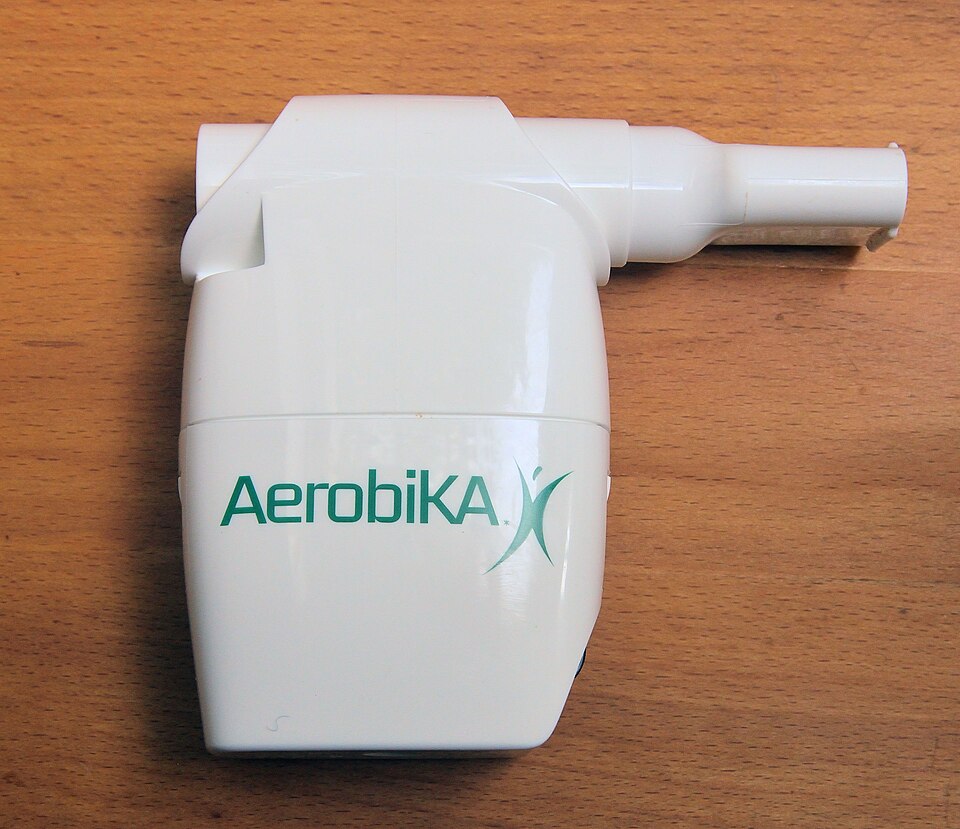
OPEP helps mobilize mucus. The clearance plan still needs an effective huff, cough, or appropriate assisted-removal method.
Aerobika by Rasbak. CC BY-SA 4.0. View larger.

Airway-clearance therapy (ACT) aims to help move and remove retained secretions. Chest physiotherapy includes manual techniques such as percussion, vibration, and postural drainage; devices provide other ways to mobilize mucus or augment a weak cough.
The important distinction is mobilization versus removal. Moving secretions toward larger airways still requires an effective cough, a huff, or another appropriate clearance method.
Compare the device families
| Method | Main action |
|---|---|
| PEP | Exhaling against resistance produces positive expiratory pressure. Requires the appropriate interface and expiratory technique. |
| Oscillating PEP (OPEP) | Adds oscillation to PEP. Examples include Aerobika and Acapella. Resistance and breathing instructions depend on the device and patient. |
| High-frequency chest-wall oscillation (HFCWO) | A vest applies external chest-wall oscillation/compression to help mobilize secretions. It does not replace an effective clearance route. |
| Intrapulmonary percussive ventilation (IPV) | Delivers rapid gas pulses at the airway. This differs from external vest oscillation and requires trained setup and monitoring. |
| Mechanical insufflation–exsufflation (MI-E) | Applies positive-pressure inflation followed by negative-pressure exsufflation to augment an ineffective cough. CoughAssist is one device family. |
Match the method to the problem
Assess retained secretions, cough strength, patient cooperation, tolerance, and response. Routine ACT is not automatically beneficial for every patient with COPD, pneumonia, or postoperative status. The cited AARC guideline addresses hospitalized patients without cystic fibrosis; disease-specific pathways may differ.
When respiratory-muscle weakness makes cough ineffective, cough augmentation may be more important than adding another secretion-mobilizing device.
OPEP: technique and clearance
For an Aerobika-type setup, check assembly, a good seal, and the clinician-selected resistance. Follow its breathing sequence and include the prescribed huff/cough steps to expel mobilized secretions.
Do not turn the resistance to maximum simply because it feels stronger. Observe a return-demonstration, assess the result, and follow the actual device’s cleaning instructions. Aerobika’s instructions call for stopping if dizziness, lightheadedness, or discomfort occurs.
Vest, IPV, and cough-assist checks
- Vest: check fit and the prescribed program; plan how loosened secretions will be removed.
- IPV: confirm the correct circuit, interface, and device-specific setup. For the cited IPV-2C, artificial-airway use requires continuous, one-to-one observation by a clinician, including assessment for help clearing mobilized secretions.
- MI-E: confirm the indication, interface, prescribed pressures and timing, and patient response. Positive and negative pressures are separate settings; there is no universal pressure pair for every patient.
Review each device’s contraindications and precautions before treatment, including relevant barotrauma risk, bleeding, or chest-wall concerns. Monitor tolerance and clinical response; more intensity is not automatically more effective.
Study example
A patient has retained secretions and a very weak cough. A vest may mobilize mucus, but the plan is incomplete if the patient cannot remove it. Assess cough effectiveness and the need for an appropriate assisted-clearance method.
For related equipment, see humidity and secretion management and nebulizer setup.
Sources
- Strickland SL, et al. AARC Clinical Practice Guideline: Effectiveness of Nonpharmacologic Airway Clearance Therapies in Hospitalized Patients. 2013.
- Monaghan Medical. Aerobika oscillating positive expiratory pressure device instructions for use. January 2026.
- Sentec/Percussionaire. IPV-2C user manual.
- Philips. CoughAssist T70/E70 suggested protocol and patient-selection guidance.
Last updated October 28, 2026.