Equipment
HFNC: flow, oxygen, and humidification
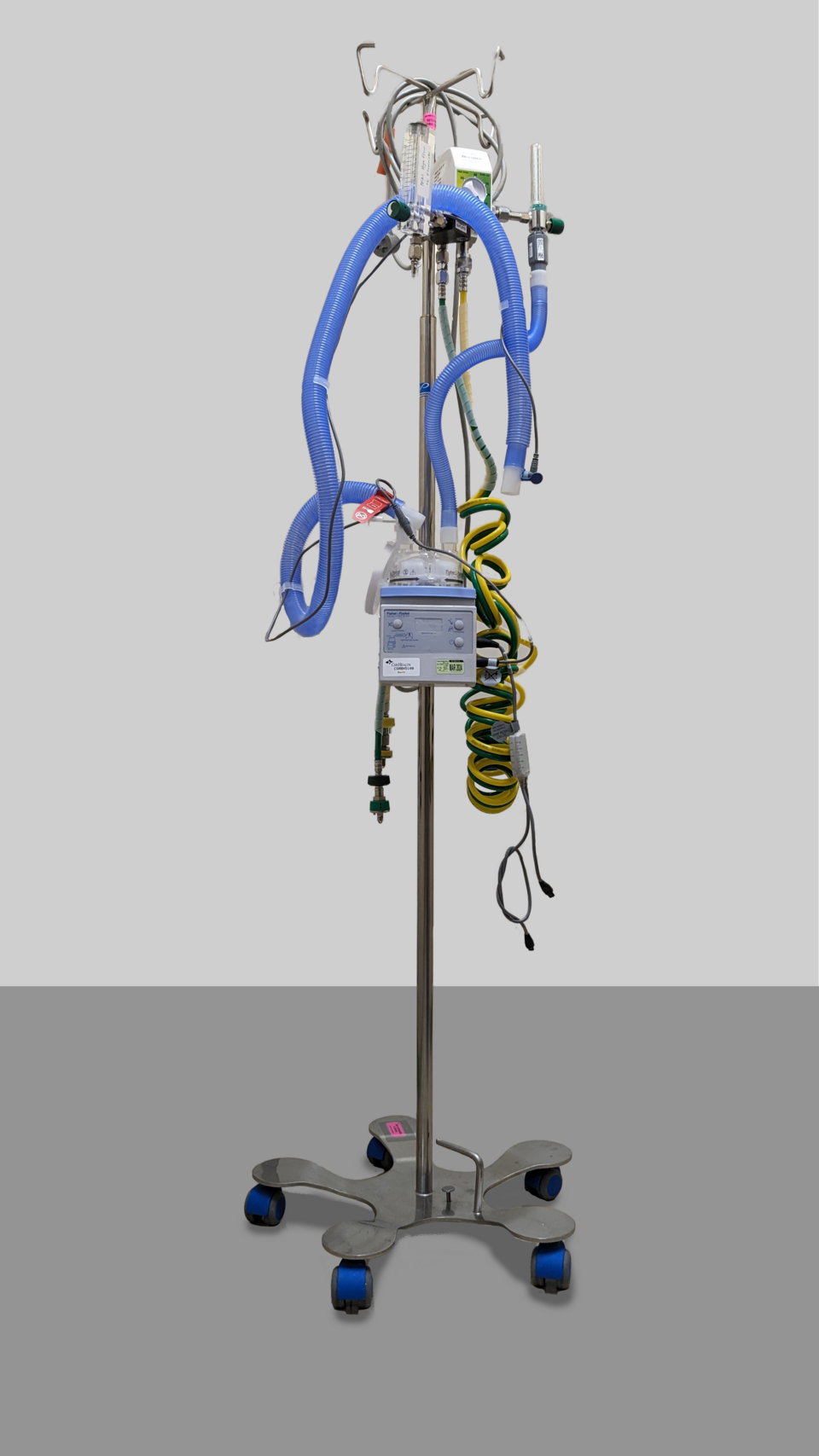
A high-flow setup brings together the gas supply, heated humidifier, breathing circuit, and patient interface. Check their compatibility as well as the selected flow and oxygen concentration.
High Flow Nasal Cannula Classic by BreathDriver. CC BY-SA 4.0. View larger.

High-flow nasal cannula (HFNC) delivers heated, humidified gas through a nasal interface to a spontaneously breathing patient. It combines a flow source, oxygen supply or blender, heated humidifier, heated circuit, and compatible cannula.
HFNC is a respiratory support system, not an ordinary nasal cannula attached to a higher flowmeter setting.
Read three separate settings
| Setting | What it describes |
|---|---|
| Flow, in L/min | Total gas delivered by the system. Higher flow can better meet inspiratory demand and increase upper-airway dead-space washout. |
| FiO2, as a fraction or percentage | Oxygen concentration in the delivered gas. A flow of 40 L/min does not mean 40% oxygen. |
| Temperature | Warming and active humidification, which support comfort and airway hydration. Use the system’s approved settings and interface. |
Device limits vary. For example, the Airvo 2 has a published 2–60 L/min range across supported modes and interfaces; that range is not an adult starting prescription. Some systems blend air and oxygen directly; others add oxygen to a flow generator and display a measured concentration.
What high flow provides
- More consistent oxygen delivery: meeting more of the patient’s inspiratory demand reduces dilution by room air.
- Dead-space washout: fresh gas clears some exhaled gas from the upper airway, reducing rebreathing.
- Humidification: warm, moist gas supports secretion clearance and tolerance.
- Variable positive airway pressure: pressure depends on flow, cannula fit, breathing, and whether the mouth is open.
HFNC does not provide a fixed CPAP pressure, a set tidal volume, or guaranteed minute ventilation. Do not convert L/min into a presumed PEEP.
Assess the response
Check the gas supply, circuit connections, humidifier water and temperature, cannula fit, and device alarms. The interface must be appropriate for the patient and system.
Follow SpO2 and respiratory rate, effort, mental status, and the overall trend. Increasing support requirements or persistent distress need prompt reassessment. A better saturation alone does not establish adequate ventilation; an ABG may still be needed to assess CO2 and pH.
The 2026 ATS guideline supports HFNC for adult acute hypoxemic respiratory failure with close monitoring. For acute hypercapnic respiratory failure, NIV has a strong recommendation; HFNC has a limited, conditional role in selected milder cases with prompt escalation available. HFNC should not delay needed escalation of respiratory support.
Study example
A display reads 40 L/min, FiO2 0.50. The flow is 40 liters of gas each minute; its oxygen concentration is 50%. Neither value tells you the patient’s PaCO2 or a fixed airway pressure.
Review pulse oximetry for saturation limitations and mask types for other interfaces.
Sources
- Fisher & Paykel Healthcare. Airvo 2 system: components, interfaces, and operating range.
- Fisher & Paykel Healthcare. Optiflow nasal high flow: mechanisms of action.
- Goel NN, et al. Noninvasive respiratory support for adult patients with acute respiratory failure: an official ATS Clinical Practice Guideline. 2026.
Last updated October 28, 2026.