Equipment
MDIs: technique, spacers, and delivery
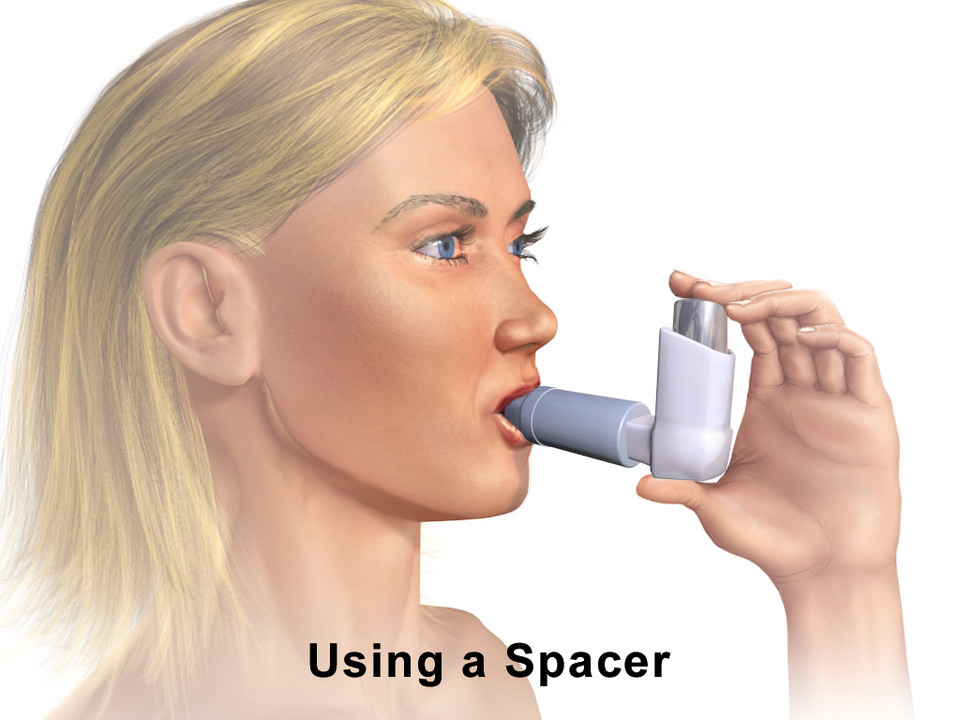
A spacer adds distance between the inhaler and the mouth. A valved holding chamber also includes a one-way valve; follow the actual inhaler and chamber instructions.
Metered-Dose Inhaler Spacer (Adult) by BruceBlaus. CC BY-SA 4.0. View larger.

A pressurized metered-dose inhaler (pMDI) releases a measured spray of medicine using a propellant. Effective delivery depends on preparation, coordination, and inhalation technique.
Recognize the basic technique
For a conventional, manually actuated pMDI used through a mouthpiece:
- Identify and inspect: confirm the medicine, prescribed dose, device, expiration date, dose indicator, and clear mouthpiece. Use the matching canister and actuator.
- Prepare: remove the cap; shake and prime only as directed for that product.
- Exhale: sit or stand upright and breathe out comfortably, away from the device.
- Inhale and actuate: seal your lips around the mouthpiece. Begin a slow, deep inhalation and release one puff as directed, continuing to breathe in.
- Hold and exhale: hold the breath as instructed, if able, then breathe out slowly. Ventolin HFA specifies about 10 seconds, or as long as comfortable.
- Repeat correctly: if another puff is prescribed, use the product’s interval and preparation steps. Replace the cap afterward.
Spacer versus holding chamber
A spacer adds distance between the inhaler and mouth. A valved holding chamber (VHC) also has a one-way valve, reducing the need for exact actuation–inhalation coordination.
Use a compatible device, a good mouthpiece or mask seal, and one actuation at a time. Inhale promptly using the chamber’s instructions; some patients need a tidal-breathing technique. Several sprays loaded together or a long delay can reduce delivery.
Instructions differ between products
These examples show why one checklist cannot supply every inhaler’s exact numbers. Priming sprays go into the air, away from the face:
| Product | Examples from its instructions |
|---|---|
| Ventolin HFA — albuterol | Shake before each spray. Prime with 4 sprays before first use, after more than 14 days unused, or after dropping. Wait 1 minute before another prescribed puff and shake again. |
| Atrovent HFA — ipratropium | Shaking is not required. Prime with 2 sprays before first use or after more than 3 days unused. Wait at least 15 seconds between prescribed inhalations. |
Both products specify regular mouthpiece cleaning, but use their own cleaning, drying, and re-priming steps. Follow the chamber’s separate cleaning instructions too.
Device type does not identify the drug’s role
Albuterol provides quick bronchodilation. Inhaled corticosteroids (ICS) treat airway inflammation; rinse the mouth and spit after ICS use. Some prescribed ICS–formoterol regimens provide both maintenance and relief. Do not assume every ICS/LABA combination can be used that way; follow the treatment plan.
Distinguish other inhalers
- Dry-powder inhaler (DPI): requires its own loading and inspiratory-effort technique. Exhale away from the device; do not attach a spacer.
- Soft-mist inhaler: produces a liquid aerosol mechanically and has its own preparation and actuation sequence.
Check learning
Ask the patient to demonstrate with their own device. Watch preparation, seal, inhalation speed, coordination, and breath hold; correct the observed error and have them repeat the technique.
Study example: a patient fires two puffs into a VHC, waits, then inhales. The prescribed puff count alone does not establish good delivery. Correct the technique to one actuation followed promptly by inhalation, then repeat according to the inhaler and chamber instructions.
Sources
- American Association for Respiratory Care. Pulmonary Disease Aerosol Delivery Devices: a guide for health care professionals, 4th edition. 2023.
- GSK. Ventolin HFA prescribing information and instructions for use.
- Boehringer Ingelheim. Atrovent HFA prescribing information and instructions for use, via DailyMed.
- National Heart, Lung, and Blood Institute. 2020 Focused Updates to the Asthma Management Guidelines: Clinician's Guide.
Last updated October 28, 2026.