Diagnostics
Spirometry: reading the basic patterns
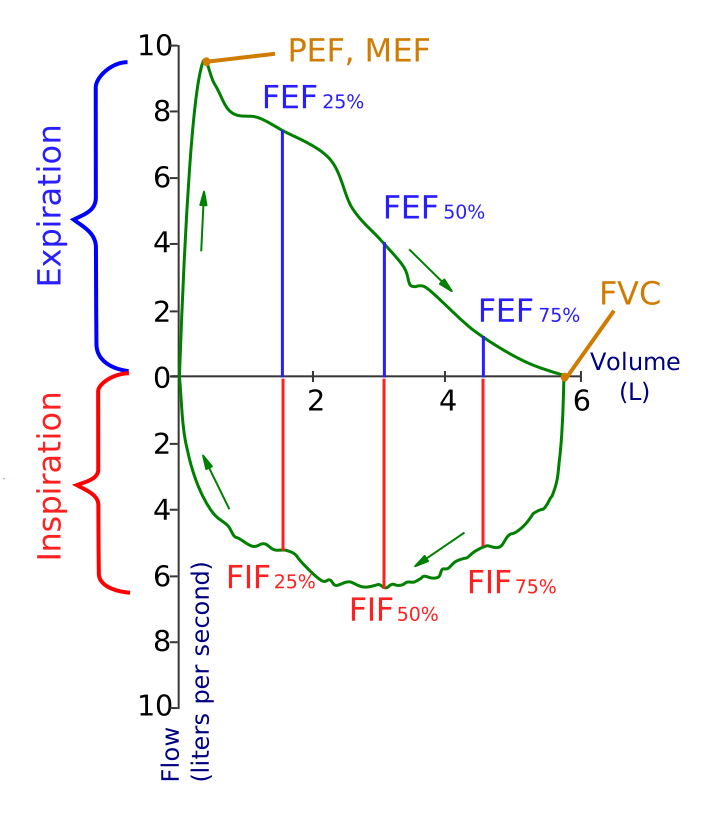
The upper limb shows expiration and the lower limb inspiration. FVC is marked at the end of forced expiration; FEV1 also requires a time measurement. Interpret the loop alongside test quality and measured values.
Flow-volume-loop by SPhotographer and Jmarchn; earlier contributors Silvermask, Prisonblues, Brady8, Mikael Häggström, Sigveholmen, and Kelly. CC BY-SA 3.0. View larger.

Spirometry measures how much air a person can move and how quickly they can move it. Start with test quality, then read the pattern. A poor maneuver can look like lung disease.
The three main values
| Value | What it tells you |
|---|---|
| FEV1 | Volume exhaled in the first second of a forced expiration. |
| FVC | Total volume exhaled forcefully after a full inspiration. |
| FEV1/FVC | Fraction of the FVC exhaled in the first second; the main spirometric measure used to identify airflow obstruction. |
Check quality first
Look for a full inspiration, a fast start, and an adequate end to expiration. Cough during the first second, leaks, and early termination can invalidate measurements.
The adult testing goal is at least three acceptable FEV1 measurements and three acceptable FVC measurements. The two largest FEV1 values should agree within 150 mL; the same rule applies separately to the two largest FVC values. Acceptable FEV1 and FVC values do not have to come from the same maneuver.
Read the pattern
The lower limit of normal (LLN) is generally the fifth percentile of the reference population, corresponding to a z-score of about −1.645. Use the report’s reference limits rather than a universal 80% predicted cutoff.
| Finding | Interpretation |
|---|---|
| FEV1/FVC below the LLN | Obstructive ventilatory impairment. |
| FVC below the LLN with a preserved ratio | Possible restriction or another cause of reduced FVC; spirometry alone cannot confirm restriction. |
| Low ratio and low FVC | Obstruction with possible air trapping or an additional restrictive impairment; lung volumes distinguish them. |
Restriction requires a total lung capacity (TLC) below the LLN. Spirometry does not measure TLC. A mixed impairment requires both a low FEV1/FVC and a low TLC.
Calculate bronchodilator response
The 2022 ERS/ATS interpretation standard defines a positive response as an increase in FEV1 or FVC greater than 10% of that value’s predicted value:
Response (%) = 100 × (post-bronchodilator − pre-bronchodilator) / predicted
Use the predicted value as the denominator. This differs from the older adult criterion of an increase of at least 12% from baseline and at least 200 mL. Keep the two methods separate when reading older course material.
Worked example
FEV1 is 1.80 L before bronchodilator and 2.15 L afterward. Predicted FEV1 is 3.00 L.
100 × (2.15 − 1.80) / 3.00 = 11.7% of predicted.
This meets the 2022 response criterion. It does not, by itself, establish asthma or distinguish asthma from COPD.
Common mistakes
- Calling a low FVC “confirmed restriction” without measuring TLC.
- Using a fixed FEV1/FVC of 0.70 as a universal LLN across ages.
- Treating a physiologic pattern as a complete clinical diagnosis.
Sources
Last updated October 28, 2026.