Equipment
SVNs: setup, delivery, and cleaning
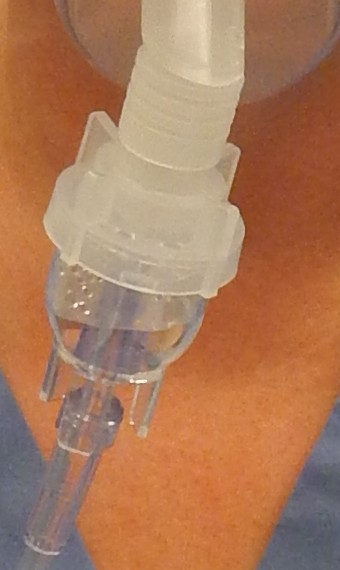
Acorn-style jet nebulizer cup, shown close up. Identify the upper aerosol outlet, medication reservoir and baffle, and gas inlet at the base. The exact product model is not identified by the source; assembly and flow are device-specific.
Nebulizer, cup detail by James Heilman, MD. CC BY-SA 4.0. Cropped from the original photo to focus on the nebulizer cup. View larger.

A small-volume nebulizer (SVN) turns liquid medication into an inhalable aerosol. The nebulizer, medication formulation, driving system, and patient interface must work together.
Identify the aerosol generator
| Type | Setup distinction |
|---|---|
| Jet nebulizer | Uses pressurized gas from a compatible compressor or approved gas source. Flow and pressure affect aerosol generation. |
| Vibrating-mesh nebulizer | Uses an electrically powered mesh to generate aerosol. The generator does not need driving gas, but its attached interface or respiratory-support system may still require gas flow. |
A mesh nebulizer is not simply a jet cup connected to the same tubing. Follow the instructions for the complete system, including its controller and interface.
Prepare and assemble
- Verify the medication, prescribed dose, concentration, expiration date, and device compatibility. Combine drugs or add diluent only as ordered and approved.
- Perform hand hygiene and use the required clean or aseptic technique. Inspect and assemble the correct cup, baffle or mesh unit, tubing, and interface.
- Use the specified fill volume. Too little, too much, or an incompatible formulation can change delivery.
- Connect the correct driving source or controller. For a jet, verify both the specified flow and source performance; 6–8 L/min is not a universal setting.
- Position the patient upright when possible and maintain the reservoir orientation required by the device.
Product example: the cited PARI LC PLUS/STAR instructions specify a compatible source delivering 3.5–8 L/min at at least 20 psi. Maximum fill is 8 mL for LC PLUS and 6 mL for STAR. These are examples from those products, not settings for every SVN.
Deliver and assess
Use an effective mouthpiece seal or a close-fitting mask suited to the patient. Holding a mask away from the face—“blow-by”—can markedly reduce delivery. Follow the device’s breathing instructions; quiet tidal breathing is common for many SVNs.
Observe aerosol production, reservoir position, patient tolerance, and treatment response. Compare the relevant assessment before and after therapy, such as breathing effort, breath sounds, and symptoms.
The endpoint depends on the system. PARI describes medication completion or slight sputtering; mesh systems use their own completion and controller instructions. A generic treatment timer or visible mist alone does not prove the prescribed dose reached the lungs.
Cleaning depends on the setting
Reusable home jet systems: clean, disinfect, dry, and replace components on the manufacturer’s schedule. PARI’s cited instructions specify not washing the air tubing. Do not apply its cup-cleaning method to every mesh unit or controller.
Hospital systems: follow the device’s approved handling and facility infection-control policy. CDC guidance specifies sterile nebulization fluid, aseptic dispensing, and appropriate cleaning/disinfection, sterile-water rinsing when needed, and drying. A home washing routine is not a hospital reprocessing protocol.
Study example
A setup produces no aerosol. Identify whether it is a jet or mesh system before troubleshooting. Check the relevant source or controller, connections, correct assembly, fill, and device condition. Merely increasing an oxygen flowmeter setting is not a universal solution.
Compare pMDIs and DPIs for other aerosol-delivery methods.
Sources
- American Association for Respiratory Care. Pulmonary Disease Aerosol Delivery Devices, 4th edition. Small-volume nebulizers. 2023.
- PARI. LC PLUS and LC STAR reusable nebulizer instructions for use, US edition.
- Aerogen. Aerogen Solo vibrating-mesh nebulizer product information and FAQs.
- CDC/HICPAC. Guidelines for Preventing Health-Care-Associated Pneumonia, 2003. Small-volume medication nebulizer handling.
Last updated October 28, 2026.