Equipment
Humidity setup: heated systems and HMEs
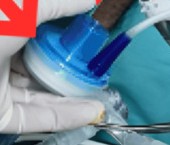
A real heat-and-moisture exchange filter (HMEF). An HMEF combines humidification and filtration; a bacterial/viral filter alone may not humidify. Check the device label.
HME filter, detail of Figure 1 by Ökkeş Hakan Miniksar and colleagues (Cureus, 2026). CC BY 4.0. Cropped from Figure 1 to show the device. View larger.
The upper airway normally warms and humidifies inspired gas. An artificial airway bypasses much of that function, so invasive mechanical ventilation requires humidification.
Active versus passive
| System | What it does |
|---|---|
| Heated humidifier | Adds heat and water vapor using a chamber, heater, compatible circuit, and sensing system. |
| Heat-and-moisture exchanger (HME) | Recovers some heat and moisture from exhaled gas and returns it during inspiration. Adds apparatus dead space and resistance. |
| HME with filter (HMEF) | Combines passive humidification with filtration. A bacterial filter alone is not necessarily an HME. |
Thick, bloody, or copious secretions, substantial leaks, and low-tidal-volume ventilation can make an HME a poor choice. Select the method for the patient and circuit, not convenience alone.
Set up a heated system
- Match the components: confirm the humidifier, chamber, breathing circuit, patient interface, and therapy mode are compatible. Invasive ventilation, NIV, and nasal high flow use different configurations.
- Position the humidifier: secure it level and below the patient, following the circuit instructions.
- Use the specified water: fill or connect the approved supply within the stated limits. The USA F&P 950 instructions specify USP Sterile Water for Inhalation or equivalent. Do not substitute saline or add medication to the chamber.
- Connect heating and sensing: check the heater-wire connection, sensor placement, and circuit assembly. Confirm the selected mode and required checks before use.
- Reassess: inspect water supply, connections, displayed values, alarms, secretions, and condensate throughout therapy.
MR850: chamber and airway temperature probes must be seated correctly. Do not assume its usual chamber-temperature display is the temperature at the patient.
F&P 950: uses a sensor cartridge and compatible circuits with integrated sensing. Use the circuit and mode intended for that therapy; a setting from a different system is not automatically transferable.
Understand the reference values
The 2012 AARC guideline suggests 33–44 mg H2O/L for active humidification during invasive ventilation, with 34–41°C at the Y-piece and 100% relative humidity. It suggests HME output of at least 30 mg H2O/L.
At 37°C and 100% relative humidity, gas contains approximately 44 mg H2O/L. This is a physiologic reference, not a universal heater-dial setting. Follow the actual system’s control and alarm instructions.
Manage rainout and resistance
Prevent condensed water from reaching the patient. Handle it as contaminated fluid and dispose of it according to policy; never return it to the humidifier reservoir. Visible condensation alone does not prove that airway humidification is adequate.
Do not combine an active heated humidifier with a patient-side HME/HMEF. Water loading can increase resistance or obstruct flow. This is different from using a bacterial filter specifically approved for that heated circuit.
Study example
A heated circuit is running, but an HME remains at the patient connection. Recognize the incompatible combination and follow the device and facility procedure to correct it. Increasing heater output does not solve the added resistance risk.
For nasal high-flow components, review HFNC.
Sources
- Restrepo RD, Walsh BK. AARC Clinical Practice Guideline: Humidification During Invasive and Noninvasive Mechanical Ventilation. 2012.
- Fisher & Paykel Healthcare. MR850 respiratory humidifier user instructions, USA.
- Fisher & Paykel Healthcare. F&P 950 respiratory humidifier user instructions, USA.
- Fisher & Paykel Healthcare. F&P 950 adult ventilator circuit instructions.
- Dräger. Evita V300 instructions for use: humidification and HME compatibility.
Last updated October 28, 2026.