Equipment
Ventilators: Hamilton and other hospital systems
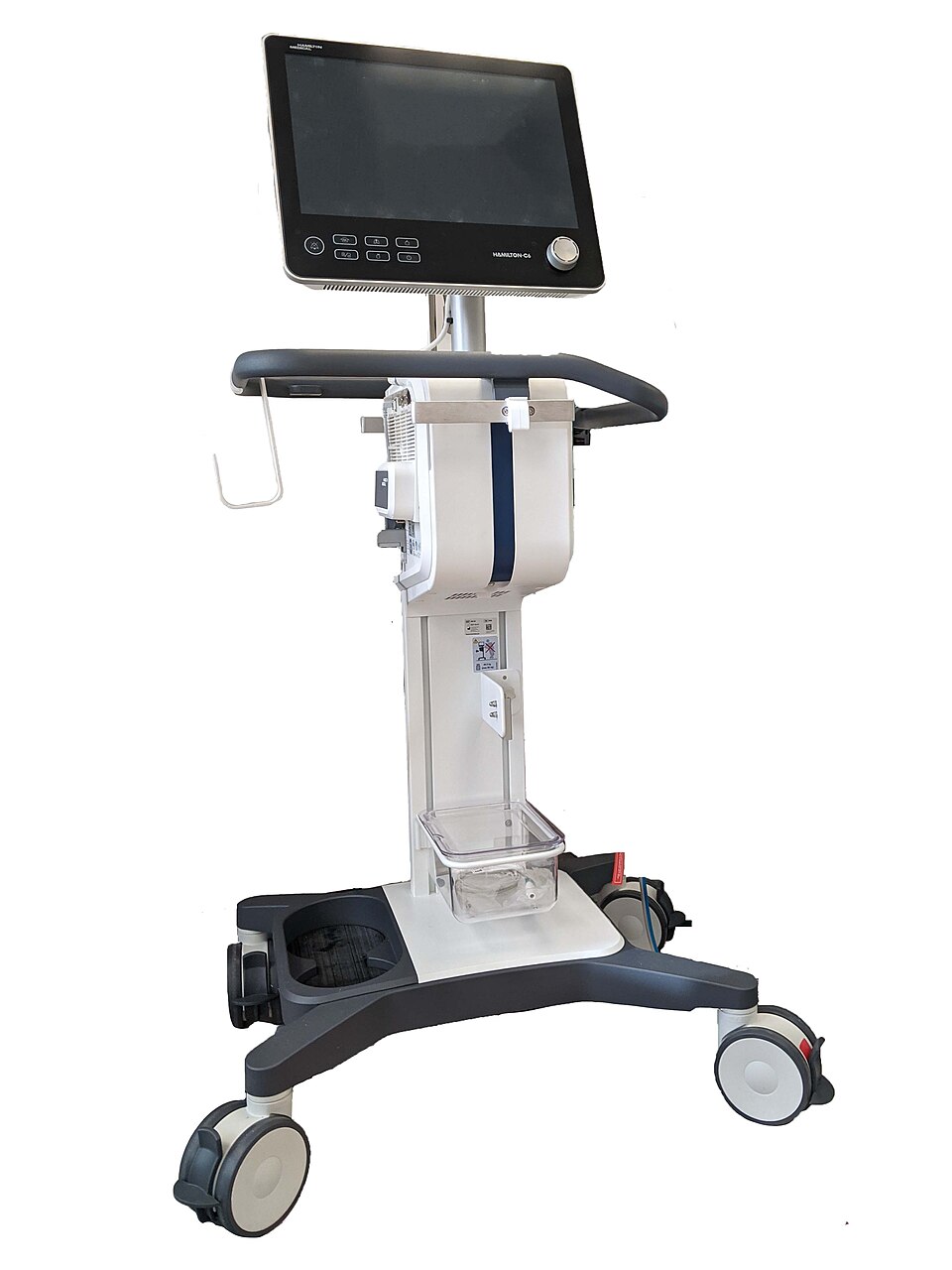
A Hamilton C6. Identify the exact model and software before comparing mode names, controls, and available options.
Hamilton C6 by BreathDriver. CC BY-SA 4.0. View larger.

Learn the manufacturer, model, software version, and circuit before the mode abbreviation. Available features differ by configuration, patient category, and market. This overview helps you recognize systems; hands-on operation follows the exact device manual and your clinical training.
Hospital ventilator families
| System | Terms and features to recognize |
|---|---|
| Hamilton — C6 and legacy G5 | APVcmv / (S)CMV+ and APVsimv / SIMV+ use adaptive pressure control to target tidal volume. ASV is Adaptive Support Ventilation, a separate automated support strategy. |
| Getinge — Servo-u / Servo-i | Recognize VC, PC, PRVC, and pressure support. On Servo-u, PRVC adapts inspiratory pressure to a volume target. Optional NAVA uses diaphragm electrical activity through an Edi catheter system. |
| Puritan Bennett — PB980 | Separate the breath sequence (A/C, SIMV, SPONT) from the mandatory breath type (VC, PC, VC+). Optional PAV+ provides proportional support for spontaneous breathing; it is not another name for PRVC. |
| Dräger — Evita V600/V800 and older V500 | Look for VC-, PC-, and SPN- labels. SPN-CPAP/PS provides spontaneous breathing with pressure support. AutoFlow modifies delivery in volume-controlled modes. A label such as PC-BIPAP does not by itself mean mask NIV. |
| Philips Respironics — V60 / V60 Plus | Hospital ventilatory-assist systems used especially for NIV in spontaneously breathing patients. Recognize CPAP, S/T, PCV, and AVAPS. Check IPAP, EPAP, the interface, and the required exhalation pathway. |
New Jersey example: Saint Peter’s Healthcare System specifically lists Servo-U and Servo-I in its respiratory therapy careers information. Equipment varies by hospital and unit; this is a documented local example, not a statewide equipment ranking.
Legacy equipment: Hamilton identifies the G5 as discontinued, Medtronic ended PB980 manufacturing in March 2024, and Philips discontinued V60/V60 Plus. Service arrangements and device status are model-specific; these names remain relevant when learning about existing equipment.
Translate the mode, not just its name
For any mode, ask:
- What initiates a breath? Patient effort, a timer, or both?
- What is controlled and targeted? A volume-controlled breath differs from a pressure-controlled breath that adapts pressure toward a volume target.
- What ends inspiration? Time, flow, or another cycling rule?
- Which breaths are mandatory or spontaneous? A/C, SIMV, and spontaneous modes describe different breath sequences.
APV, PRVC, VC+, AutoFlow, and AVAPS use different implementations. A similar goal does not establish identical timing, leak handling, pressure limits, or response to patient effort.
Checks that carry across brands
- Set versus measured: distinguish the set rate from total rate, the selected tidal volume from exhaled volume, and pressure settings from measured pressures.
- Oxygenation and ventilation: identify FiO2 and PEEP separately from the variables determining breath size and frequency. Assess gas exchange and the patient, not settings alone.
- Pressure reference: verify whether an inspiratory pressure is displayed above PEEP or as an absolute level. For NIV using absolute IPAP and EPAP settings, pressure support equals IPAP minus EPAP. Other two-pressure-level modes can have separate pressure-support controls.
- Circuit and readiness: confirm patient category, circuit, humidification, gas and power supplies, and the required pre-use checks.
- Alarms: locate high-pressure, low-volume/minute-ventilation, apnea/disconnection, oxygen-supply, and power alerts as applicable. Assess the patient promptly and investigate the cause; silencing an alarm does not correct it.
Study example
A Hamilton display says APVcmv and shows a target tidal volume. That does not make the breath conventional fixed-flow volume control: the ventilator adjusts inspiratory pressure toward that target. Confirm measured exhaled volume, pressure limits, and patient interaction.
For related measurements, review respiratory mechanics formulas, ABG interpretation, and NIV mask compatibility.
Sources
- Hamilton Medical. HAMILTON-C6 operator's manual, software 1.2.x.
- Hamilton Medical. Comparison of volume-targeted and volume-controlled modes.
- Getinge. Servo-u mechanical ventilator: modes, monitoring, and configuration.
- Medtronic. Puritan Bennett 980 ventilator operator's manual, US edition.
- Dräger. Evita V800/V600 instructions for use, software 2.n.
- Philips. Respironics V60/V60 Plus user manual.
- Saint Peter's Healthcare System. Allied Health Careers: Respiratory Therapy. New Jersey equipment example, checked October 2026.
- Hamilton Medical. Discontinuation of the HAMILTON-G5 and its successor.
- Medtronic. PB980 manufacturing and service support letter. March 2024.
- Philips. V60/V60 Plus remediation information and continued service support.
Last updated October 28, 2026.