Airway suctioning
Suction an artificial airway only when indicated, with preoxygenation, a catheter under half the lumen, limited pressure, and 15 seconds or less.
- Catheter size< 50% of lumenAARC 2022 text; see note on the table
- Suction pressure, adultBelow -200 mmHgAs low as effective
- Duration≤ 15 secondsPer suctioning event
- Nasotracheal, adult-100 to -150 mmHgAARC 2004; do not exceed 150
Suctioning removes secretions that the patient can’t clear through an artificial airway. It also drops oxygen, raises heart rate and blood pressure, and irritates the airway. Do it when there is a reason, and make each pass short and gentle.
When to suction
The AARC 2022 guideline names three indicators for adults and children: breath sounds that suggest secretions (coarse sounds), visible secretions in the airway, and a sawtooth pattern on the ventilator flow or volume waveform. Suction on need, not on a fixed schedule. A sudden rise in peak pressure without a rise in plateau pressure also points to secretions (see ventilator graphics).
Technique points from the guideline
| Step | Guideline position |
|---|---|
| Preoxygenate | Adult and pediatric patients should be preoxygenated. The 2010 guideline used 100% oxygen through the ventilator’s preoxygenation function or by turning up FiO2, not by manual bagging. The 2022 review notes that raising FiO2 by about 0.2 above baseline may be enough. |
| Catheter size | The catheter should occlude less than 50% of the tube lumen in adults (the 2022 text and abstract). The 2022 summary table lists 70% for all ages, but 50% is the long-standing adult rule. |
| Suction pressure | Keep it below -200 mmHg in adults and as low as will clear secretions. Neonates and children: below -120 mmHg. |
| Duration | As brief as possible and no longer than 15 seconds per suctioning event. |
| Depth | Use shallow suction routinely (catheter to the end of the tube). Use deep suction (until resistance, then pull back 1 cm) only if shallow fails, because it risks airway trauma. |
| Open or closed | Either system is safe and effective for adults. |
| Technique | Use sterile technique for open suctioning when possible. Hand hygiene is the minimum. |
| Saline | Don’t routinely instill saline. It is unnecessary and several small studies showed worse oxygenation. |
| Bronchoscopy | Not for routine secretion removal. |
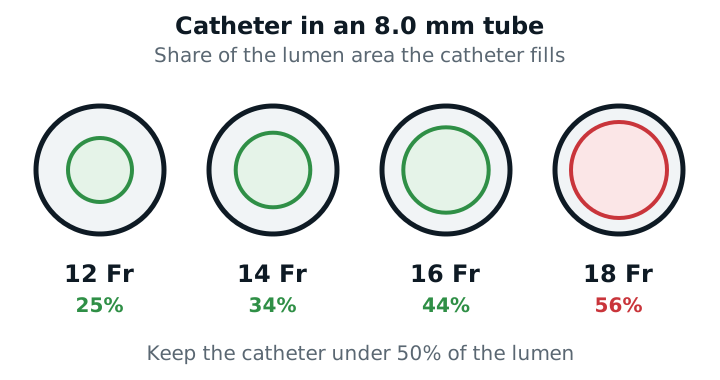
A common bedside rule for sizing gives the same answer: catheter size (Fr) = (tube ID in mm × 3) ÷ 2, which is 12 Fr for an 8.0 tube. That catheter’s diameter is half the tube’s, but it fills only about a quarter of the lumen’s area.
The simple version to remember: the catheter should leave plenty of room for air to move around it, or ventilation and oxygenation fall while you suction.
Complications
Desaturation, higher heart rate and blood pressure, arrhythmias, raised intracranial pressure, mucosal trauma, and infection. Preoxygenation, adequate sedation, and suctioning only when indicated reduce them. Watch SpO2, heart rate, and rhythm, and stop if the patient deteriorates.
Nasotracheal suctioning
NTS passes a catheter through the nose and pharynx into the trachea for a patient without an artificial airway who can’t clear secretions. The AARC 2004 guideline uses a sterile, flexible, multi-eyed catheter and applies suction only as the catheter is withdrawn. Adult pressures are -100 to -150 mmHg and should not exceed -150, and suction time should not exceed 15 seconds. Contraindications include blocked nasal passages, nasal bleeding, coagulopathy, laryngospasm, bronchospasm, recent head, face, or neck injury, and epiglottitis or croup (absolute). Hyperoxygenate first.
Study example
A ventilated man with an 8.0 tube has coarse breath sounds, and the flow-time scalar shows a sawtooth line. His baseline FiO2 is 0.40. You raise it to 0.60 (or use the ventilator’s preoxygenation function), use a closed 12 Fr catheter, set suction at -120 mmHg, pass the catheter to the end of the tube, and apply suction for about 10 seconds. The sawtooth is gone and he sounds clearer, so you return the FiO2 to 0.40 and note the secretion color and amount.
See tracheostomy care, endotracheal intubation, ventilator graphics, and humidity setup.
Sources
- Blakeman TC, Scott JB, Yoder MA, Capellari E, Strickland SL. AARC Clinical Practice Guidelines: Artificial airway suctioning. Respir Care. 2022;67(2):258-271.
- AARC Clinical Practice Guideline: Endotracheal suctioning of mechanically ventilated patients with artificial airways 2010. Respir Care. 2010;55(6):758-764.
- AARC Clinical Practice Guideline: Nasotracheal suctioning, 2004 revision and update. Respir Care. 2004;49(9):1080-1084.
- Goodfellow LT, et al. AARC Clinical Practice Guideline: Patient-ventilator assessment. Respir Care. 2024;69(8):1042-1054.