Study notesMechanical ventilation
Initial ventilator settings
Set tidal volume from predicted body weight, then choose rate, FiO2, PEEP, flow, I:E, and trigger. Keep plateau pressure at or below 30 cm H2O.
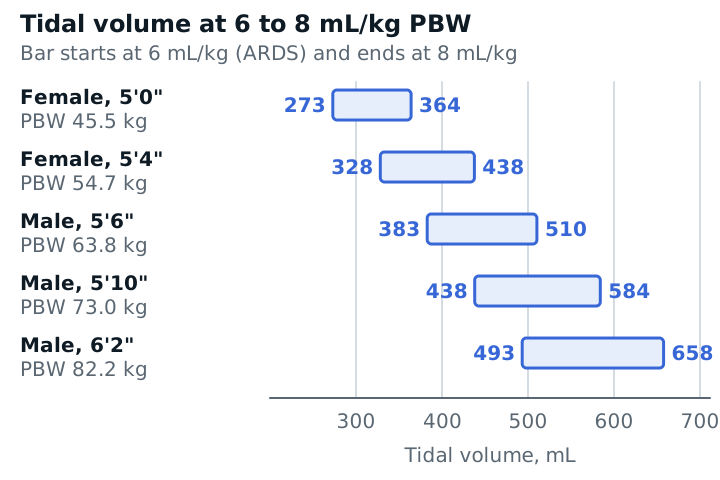
- Tidal volume6–8 mL/kg PBW6 mL/kg PBW in ARDS
- Plateau pressure≤ 30 cm H2OMeasured with an inspiratory pause
- Starting PEEP5 cm H2OARDSNet minimum; 5–8 commonly used
- Driving pressurePplat − PEEP15 cm H2O used as a safety limit
Initial settings are a starting point built from the patient’s height and sex, not their actual weight. You then check pressures and a blood gas and adjust. The goal is enough gas exchange without stretching the lungs.
Start with predicted body weight
Lung size follows height and sex, so tidal volume (VT) is set per kg of predicted body weight (PBW). Use inches:
- Male: PBW = 50 + 2.3 × (height in inches − 60)
- Female: PBW = 45.5 + 2.3 × (height in inches − 60)
An actual weight of 140 kg does not make the lungs bigger. Document VT as mL/kg PBW; the AARC patient-ventilator assessment guideline makes this a strong recommendation.
The settings
| Setting | Usual start | Notes |
|---|---|---|
| Tidal volume | 6–8 mL/kg PBW | Use 6 mL/kg for ARDS. The ARDSNet protocol starts at 8 mL/kg and steps down by 1 mL/kg every 2 hours or less until it reaches 6. |
| Rate | About 12–16/min for a normal patient | Match the patient’s baseline minute ventilation (normal is 7–10 L/min). ARDSNet caps the set rate at 35/min. A patient with metabolic acidosis may need a higher rate to start. |
| FiO2 | Often 1.0 at first in an emergency | Titrate down as soon as SpO2 allows, ideally below 0.5. Targets vary by source: SpO2 94–98% for most critically ill adults, and 88–95% in ARDS (ARDSNet; the AARC suggests 88–93% for severe ARDS on a high-PEEP strategy). |
| PEEP | 5 cm H2O minimum | ARDSNet sets a floor of 5. Other sources start at 5–8 and raise in steps of 2 cm H2O. |
| Inspiratory flow (VC) | About 60 L/min | Higher flow shortens inspiration and lengthens expiration, which helps patients with airflow obstruction. |
| I:E ratio | About 1:2 | 1:3 or longer when air trapping is a risk (COPD, asthma). Inspiration should be shorter than expiration. |
| Trigger | -1 to -3 cm H2O, or 2–3 L/min | Sensitive enough that the patient does not strain, but not so sensitive that the ventilator auto-triggers. |
Pressure limits
- Plateau pressure (Pplat) is the pressure on the alveoli at the end of inspiration, measured with a 0.5 second inspiratory pause. Keep it ≤ 30 cm H2O. If Pplat is above 30, lower VT in 1 mL/kg steps, to a minimum of 4 mL/kg PBW (ARDSNet).
- Peak inspiratory pressure (PIP) is higher than Pplat because it includes airway resistance. One review gives a limit of roughly 35–40 cm H2O.
- Driving pressure = Pplat − PEEP. In a large analysis of ARDS trials, driving pressure was the ventilator variable most strongly linked to survival. Some sources use 15 cm H2O as a safety limit; it is not a proven target.
The original ARDSNet trial compared 6 and 12 mL/kg PBW and found mortality of 31.0% versus 39.8%.
Study example
A man is 70 inches tall (5 ft 10 in). PBW = 50 + 2.3 × (70 − 60) = 73.0 kg. At 6 mL/kg, VT = 438 mL; at 8 mL/kg, VT = 584 mL. If he has ARDS, start near 440 mL. Set a rate of 14/min and PEEP 5, then measure Pplat. A Pplat of 33 cm H2O means lowering VT by 1 mL/kg (to about 5 mL/kg, 365 mL) and checking again.
See ventilator modes, adjusting ventilation from ABGs, ventilator graphics, and ARDS.
Practice these settings on a live patient in the ventilator simulator.
Sources
- ARDS Network (NIH NHLBI). Mechanical ventilation protocol summary.
- Acute Respiratory Distress Syndrome Network. Ventilation with lower tidal volumes as compared with traditional tidal volumes for acute lung injury and ARDS. N Engl J Med. 2000;342:1301-1308.
- Bayram B, Sanci E. Invasive mechanical ventilation in the emergency department. Turk J Emerg Med. 2019.
- Goodfellow LT, et al. AARC Clinical Practice Guideline: Patient-ventilator assessment. Respir Care. 2024;69(8):1042-1054.
- Amato MBP, et al. Driving pressure and survival in the acute respiratory distress syndrome. N Engl J Med. 2015;372:747-755.