ARDS: definition and lung-protective ventilation
Berlin and 2023 global definitions, P/F severity bands, 6 mL/kg ventilation, the ARDSNet PEEP/FiO2 table, prone positioning, and fluids.
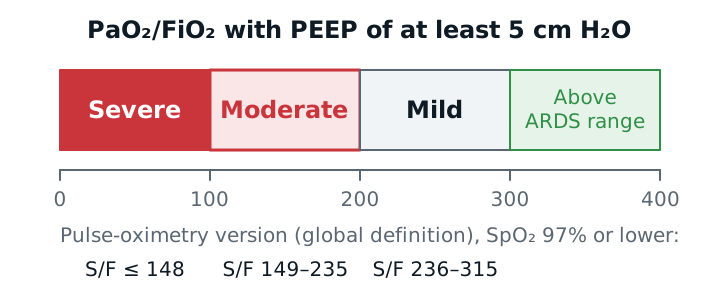
- Mild / moderate / severeP/F 300 / 200 / 100Upper limits, with PEEP of 5 cm H2O or more
- Tidal volume6 mL/kg PBWRange 4–8; start at 8 and step down
- Plateau pressure≤ 30 cm H2OCheck at least every 4 hours
- Prone positioning> 12 h/dayATS 2024: severe ARDS
Acute respiratory distress syndrome (ARDS) is sudden, diffuse inflammatory lung injury. Fluid leaks into the alveoli because the vessel and alveolar walls have become permeable, the lungs get stiff, and shunt and dead space rise. Common triggers are pneumonia, sepsis, aspiration, trauma, and transfusion. How you set the ventilator changes survival, so this topic is worth knowing cold.
The definitions
The Berlin definition (2012) has four parts: onset within one week of a known insult or new or worsening symptoms; bilateral opacities on chest X-ray or CT that aren’t fully explained by effusions, collapse, or nodules; respiratory failure not fully explained by heart failure or fluid overload; and impaired oxygenation with PEEP of at least 5 cm H2O. The severity bands use PaO2/FiO2 (the P/F ratio):
| Berlin severity | PaO2/FiO2 |
|---|---|
| Mild | above 200 up to 300 |
| Moderate | above 100 up to 200 |
| Severe | 100 or less |
In the Berlin cohort, mortality rose with each band: 27%, 32%, and 45%.
The 2023 global definition
A 2023 consensus (published 2024) kept the Berlin concept and extended it:
- Nonintubated ARDS counts: PaO2/FiO2 of 300 or less, or SpO2/FiO2 of 315 or less (with SpO2 97% or lower), on high-flow nasal oxygen of at least 30 L/min or on NIV or CPAP with at least 5 cm H2O.
- SpO2/FiO2 bands can replace PaO2/FiO2: mild 236 to 315, moderate 149 to 235, severe 148 or lower.
- Ultrasound (bilateral B-lines or consolidation) is accepted as imaging.
- A modified definition for resource-limited settings doesn’t require PEEP or a minimum oxygen flow.
- For intubated patients, PEEP of at least 5 cm H2O is still required.
Lung-protective ventilation
The ARDS Network protocol, backed by the 2024 ATS guideline, is built on a few numbers:
- Work out predicted body weight (PBW) from height. Male: 50 + 2.3 × (height in inches − 60). Female: 45.5 + 2.3 × (height in inches − 60).
- Start at 8 mL/kg PBW and cut by 1 mL/kg every 2 hours or less until you reach 6 mL/kg. ATS recommends a range of 4 to 8 mL/kg.
- Check plateau pressure at least every 4 hours and after each change in PEEP or tidal volume. Keep it at or below 30 cm H2O. If it’s higher, lower the tidal volume by 1 mL/kg, down to a minimum of 4.
- Oxygenation goal: PaO2 55 to 80 mmHg or SpO2 88 to 95%, with a minimum PEEP of 5. The protocol shows PEEP and FiO2 pairs; this is the “lower PEEP, higher FiO2” table:
| FiO2 | 0.3 | 0.4 | 0.4 | 0.5 | 0.5 | 0.6 | 0.7 | 0.7 | 0.7 | 0.8 | 0.9 | 0.9 | 0.9 | 1.0 |
|---|---|---|---|---|---|---|---|---|---|---|---|---|---|---|
| PEEP | 5 | 5 | 8 | 8 | 10 | 10 | 10 | 12 | 14 | 14 | 14 | 16 | 18 | 18–24 |
The protocol also has a higher-PEEP table. ATS suggests higher PEEP, without recruitment maneuvers, in moderate to severe ARDS, and recommends against prolonged recruitment maneuvers. It suggests neuromuscular blockers in early severe ARDS and recommends against routine high-frequency oscillation.
Prone positioning and fluids
ATS strongly recommends prone positioning for more than 12 hours a day in severe ARDS. Turning a patient is a team job with a plan for the tube, lines, and the face.
Once shock is resolved, a fluid-conservative approach reduces ventilator days; the Disease Primer describes aiming for 500 to 1,000 mL less net fluid per day.
Study example
A man is 70 inches tall. His PBW is 50 + 2.3 × (70 − 60) = 73 kg. At 6 mL/kg, his tidal volume is about 440 mL. If his plateau pressure is 34 cm H2O, you lower the tidal volume by 1 mL/kg (to about 365 mL) and recheck, and you watch the pH while the PaCO2 rises.
Related: initial ventilator settings, heart failure and pulmonary edema, HFNC, ABG interpretation.
Try lung-protective ventilation and PEEP titration on the ARDS patient in the ventilator simulator.
Sources
- ARDS Definition Task Force. Acute respiratory distress syndrome: the Berlin Definition. JAMA. 2012.
- Matthay MA, et al. A New Global Definition of Acute Respiratory Distress Syndrome. Am J Respir Crit Care Med. 2024.
- NHLBI ARDS Network. Mechanical Ventilation Protocol Summary.
- Qadir N, et al. An Update on Management of Adult Patients with Acute Respiratory Distress Syndrome: An Official ATS Clinical Practice Guideline. Am J Respir Crit Care Med. 2024.
- Matthay MA, et al. Acute respiratory distress syndrome. Nat Rev Dis Primers. 2019.