Acid-base compensation, anion gap, and mixed disorders
Expected compensation for each simple acid-base disorder, the anion gap with albumin correction, the delta gap, and how to spot a mixed disorder.
- Metabolic acidosis1.5 × HCO3 + 8 ± 2Winter's formula: expected PaCO2
- Resp. acidosis, HCO3 per 10+1 acute, +3–4 chronicPer 10 mmHg rise in PaCO2
- Resp. alkalosis, HCO3 per 10−2 acute, −4–5 chronicPer 10 mmHg fall in PaCO2
- Anion gapNa − (Cl + HCO3)Normal about 12 mEq/L
- Albumin correction+2.5 per 1 g/dLFor each 1 g/dL albumin below 4
After you find the primary disorder (ABG interpretation), ask whether the other system responded the way it should. A response that is too small or too large means a second disorder is hiding. These rules are rules of thumb, and they only apply to simple disorders. Compensation never returns the pH fully to normal and never overshoots it.
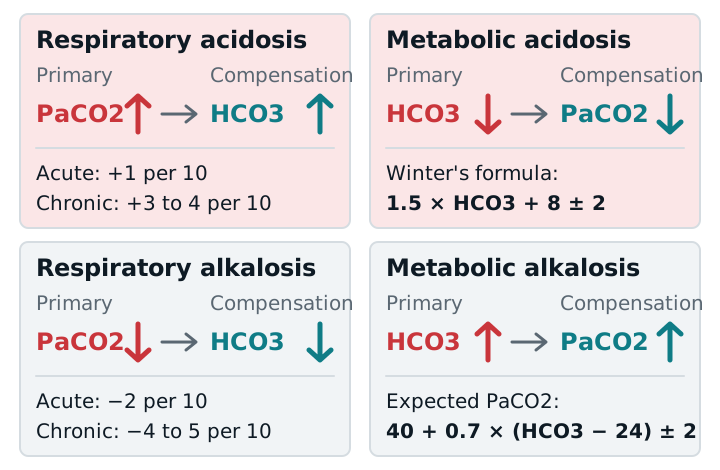
The rules
| Primary disorder | Expected compensation |
|---|---|
| Metabolic acidosis | PaCO2 = (1.5 × HCO3) + 8, ± 2 (Winter’s formula) |
| Metabolic alkalosis | PaCO2 rises about 0.6 to 0.75 mmHg per 1 mEq/L rise in HCO3. One form: 40 + 0.7 × (HCO3 − 24) ± 2. PaCO2 rarely goes above about 55. |
| Respiratory acidosis, acute | HCO3 rises about 1 per 10 mmHg rise in PaCO2 |
| Respiratory acidosis, chronic | HCO3 rises about 3 to 4 per 10 mmHg |
| Respiratory alkalosis, acute | HCO3 falls about 1 to 2 per 10 mmHg fall in PaCO2 (2 is the common teaching number) |
| Respiratory alkalosis, chronic | HCO3 falls about 4 to 5 per 10 mmHg |
Why acute and chronic differ: the lungs change PaCO2 in minutes, and blood buffers move HCO3 only a little at once. The kidneys take a few days to make a bigger change. Sources give slightly different numbers (for example, 3 to 5 for chronic respiratory acidosis, and up to 7 for chronic respiratory alkalosis on one ATS table), so use the range as a guide and use your course’s numbers on exams.
Worked example. A patient’s PaCO2 is 70 mmHg, 30 above normal. Acute: HCO3 should rise about 3, to about 27. Chronic: about 9 to 12, to about 33 to 36. A measured HCO3 of 31 falls between the two. That fits a chronic problem with a recent acute worsening. Check the history before you decide.
Anion gap
Anion gap = Na − (Cl + HCO3). Normal is about 12 mEq/L (10 to 12 in some references). Use it when HCO3 is low, to split metabolic acidosis into two groups.
- High gap: acid is added. Think ketoacidosis, lactic acidosis, kidney failure, and toxic ingestions (methanol, ethylene glycol, salicylates).
- Normal gap (hyperchloremic): bicarbonate is lost. Think diarrhea, renal tubular acidosis, and large volumes of saline.
Albumin carries negative charge, so a low albumin hides a high gap. For each 1 g/dL that albumin is below 4, add about 2.5 to the measured gap.
Delta gap and mixed disorders
In a high-gap acidosis, HCO3 should fall by about as much as the gap rises. Compare the two:
- Delta gap = measured gap − normal gap (about 12). Delta HCO3 = normal HCO3 (24) − measured HCO3.
- About equal (ratio near 1): a simple high-gap acidosis.
- Delta gap greater than delta HCO3 (HCO3 is higher than expected): a metabolic alkalosis is also present.
- Delta HCO3 greater than delta gap (HCO3 is lower than expected): a normal-gap acidosis is also present.
Mixed disorders show up as a measured compensation outside the expected range. In metabolic acidosis, a PaCO2 above the Winter’s range means a respiratory acidosis too, and one below it means a respiratory alkalosis too. Both HCO3 and PaCO2 pushing the pH the same way is a mixed disorder from the start.
Common causes
| Disorder | Think of |
|---|---|
| Respiratory acidosis | Hypoventilation: sedatives and other drugs, brainstem injury, neuromuscular weakness, COPD, severe asthma, airway edema |
| Respiratory alkalosis | Hypoxemia, anxiety or pain, fever, pulmonary embolism, CNS disease, and overventilation on a ventilator |
| Metabolic acidosis | Lactic acidosis, ketoacidosis, kidney failure, toxins, diarrhea, renal tubular acidosis |
| Metabolic alkalosis | Vomiting or nasogastric suction, diuretics, volume depletion, low potassium, bicarbonate given |
Study example
pH 7.29, PaCO2 26 mmHg, HCO3 12 mEq/L; Na 140, Cl 104. The HCO3 is low with a low pH: metabolic acidosis. Winter’s formula predicts 1.5 × 12 + 8 = 26 ± 2, so 24 to 28. The measured 26 fits: appropriate compensation. The gap is 140 − (104 + 12) = 24, which is high, so look for added acid such as lactate or ketones. Delta gap is 12 and delta HCO3 is 12, so there is no second metabolic disorder.
Try your own gases in the ABG interpreter. Related: ABG interpretation, adjusting ventilation from ABGs, capnography.
Sources
- American Thoracic Society. Interpretation of ABGs.
- Merck Manual Professional Edition. Acid-Base Disorders.
- Seifter JL, Chang HY. Disorders of acid-base balance: new perspectives. Kidney Dis (Basel). 2017;2(4):170-186.
- Merck Manual Professional Edition. Metabolic Acidosis.
- Merck Manual Professional Edition. Metabolic Alkalosis.
- Merck Manual Professional Edition. Respiratory Acidosis.