Gas cylinders, regulators, and flowmeters
US medical gas colors, E and H cylinder contents, the cylinder duration formula, safety connections, regulators, flowmeters, and liquid oxygen.
- Full cylinder2,200 psiOxygen, E and H
- Duration(psi × factor) ÷ flowMinutes; flow in L/min
- Cylinder factorsD 0.16 · E 0.28 · H 3.14Liters per psi
- Liquid oxygen1 L liquid ≈ 860 L gasExpands when it warms to room temperature
Oxygen on a transport, a power failure, or a home setup often means a cylinder. You need to read the color and label, know how long it will last, and know how it connects safely.
US color codes
| Gas | Color |
|---|---|
| Oxygen | Green |
| Air | Yellow |
| Carbon dioxide | Gray |
| Nitrous oxide | Blue |
| Helium | Brown |
| Nitrogen | Black |
These are the US colors. Other countries use different ones (oxygen is white in the international code), so read the label, not just the color.
Sizes and contents
A full E cylinder of oxygen holds about 22 ft³ (roughly 620 L) and a full H cylinder about 244 ft³ (roughly 6,900 L), both at about 2,200 psi. Multiply cubic feet by 28.3 to get liters. Dividing the liters by 2,200 psi gives the cylinder’s factor: how many liters each psi represents.
| Cylinder | Contents | Factor (L/psi) |
|---|---|---|
| D | smaller | 0.16 |
| E | about 620 L | 0.28 |
| H or K | about 6,900 L | 3.14 |
How long will it last?
Duration (min) = (gauge psi × cylinder factor) ÷ flow (L/min)
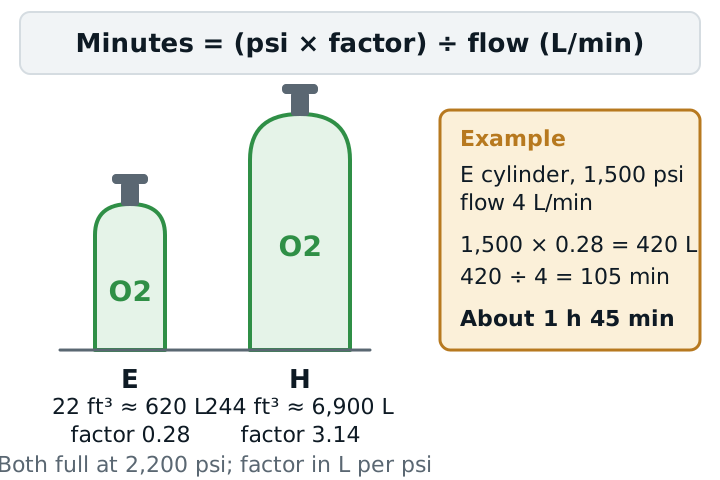
An E cylinder reads 1,500 psi and the patient is on 4 L/min: 1,500 × 0.28 = 420 L, and 420 ÷ 4 = 105 minutes. A full H cylinder (2,200 psi) at 10 L/min: 2,200 × 3.14 = 6,908 L, and 6,908 ÷ 10 = about 691 minutes, or 11.5 hours.
Many programs and hospitals also subtract a safe residual so you aren’t relying on the last gas: use (psi − residual) in place of psi. One lab handout subtracts 500 psi. The plain formula is the standard answer unless a question tells you to subtract a reserve.
Connection safety systems
- Pin Index Safety System (PISS): on E and smaller cylinders. Pins on the yoke fit holes in the valve in a pattern unique to each gas, so you can’t mount the wrong gas on a yoke.
- Diameter Index Safety System (DISS): gas-specific threaded fittings for regulators, flowmeters, and many equipment inlets. Different diameters stop a wrong connection.
- Quick-connects: wall outlet connections for hoses, with shapes and spacing unique to each gas.
Regulators and flowmeters
A reducing valve (regulator) drops the 2,200 psi in the cylinder to the working pressure of about 50 psi, the same pressure as the piped wall supply (typically 40 to 60 psi), so equipment gets a steady pressure as the cylinder empties. A flowmeter then sets the flow.
| Flowmeter | How it works | Behavior |
|---|---|---|
| Thorpe tube (float in a tapered tube) | Gas lifts a float to the flow rate; read the float’s top (or center for a ball) | Must be upright |
| Pressure-compensated Thorpe tube | Needle valve sits downstream of the float, so the tube is at working pressure | Accurate with back pressure |
| Uncompensated Thorpe tube | Needle valve upstream; tube is at atmospheric pressure | Reads lower than the real flow when something downstream resists (a nebulizer, a kink) |
| Bourdon gauge | A pressure gauge calibrated in L/min through a fixed orifice | Works in any position; reads higher than the real flow with back pressure |
Liquid oxygen
Liquid oxygen is stored very cold, and when it warms to room temperature it expands about 860 times. One liter of liquid gives roughly 860 L of gas, so a system that holds 1 L of liquid lasts 860 ÷ flow minutes (430 minutes at 2 L/min), less the gas that boils off. Liquid oxygen is a strong oxidizer: clothing soaked with it ignites easily.
Study example
You transport a patient on a non-rebreather mask at 12 L/min with an E cylinder that reads 1,000 psi. 1,000 × 0.28 = 280 L, and 280 ÷ 12 = about 23 minutes. That’s not enough for a long transport. Take a fuller cylinder, or an H on a cart, or use a different supply.
Related: oxygen mask types, HFNC, oxygen therapy principles.
Sources
- UMass Memorial Health. Staff Ed: Medical Gases (US color system and the Pin Index Safety System).
- University of Florida Department of Anesthesiology. Virtual Anesthesia Machine: High Pressure System (US color code, quick connectors, Pin Index Safety System, pressure regulators).
- Austin Community College Respiratory Care. Medical gas storage and cylinder lab (E and H contents, 2200 psig fill, duration practice).
- Respiratory Therapy Zone. How to Calculate How Long an Oxygen Tank Will Last (cylinder factors).
- Lawrence Berkeley National Laboratory EHS. Liquid Oxygen.
- Kacmarek RM, Stoller JK, Heuer AJ. Egan's Fundamentals of Respiratory Care. Elsevier. (Connection systems, flowmeters.)