Inhaled steroids and other respiratory drugs
Inhaled corticosteroids, leukotriene modifiers, mucoactive drugs, inhaled antibiotics, pulmonary vasodilators, surfactant, and the order of several aerosols.
- ICS side effectThrush, hoarsenessRinse and spit after each dose
- Dornase alfa (CF)2.5 mg dailyNebulized once daily; some patients twice
- Tobramycin (CF)300 mg BID28 days on, 28 days off
- Inhaled nitric oxide20 ppmTerm and near-term neonates with PPHN
- Aerosol orderBronchodilator firstThen mucoactive, clearance, antibiotic, ICS
Beyond the bronchodilators in bronchodilators, RTs give and monitor several other respiratory drugs: anti-inflammatories, drugs that thin or loosen secretions, inhaled antibiotics, and drugs that open the pulmonary blood vessels. This page covers what each is for, its main hazard, and how to order them when several are due at once.
Inhaled corticosteroids (ICS)
ICS (fluticasone, budesonide, and others) reduce airway inflammation. They are controller drugs for asthma, not rescue drugs: the Flovent label says plainly that it is not for acute bronchospasm. They take days to weeks to work.
- Side effects are local. Oral thrush (candidiasis) and a hoarse voice (dysphonia) are the usual ones; GOLD also lists skin bruising and a higher pneumonia risk in COPD.
- Rinse your mouth with water and spit, without swallowing, after each dose. This lowers the thrush risk (label instruction). For MDI technique, see MDI technique.
- Combination inhalers pair an ICS with a LABA, which works better than either alone for lung function and symptoms (GOLD). A LABA is never given without an ICS in asthma.
Leukotriene modifiers
Montelukast is a tablet or granule taken by mouth, not an inhaled drug. It blocks the leukotriene pathway and is used as an add-on controller in asthma. It is not for acute attacks, and the label carries a boxed warning for serious neuropsychiatric events (agitation, depression, sleep problems, suicidal thoughts). Patients still keep a rescue inhaler.
Mucoactive drugs
| Drug | Use | What to watch |
|---|---|---|
| Dornase alfa | Cystic fibrosis (CF): breaks down DNA in thick sputum. 2.5 mg nebulized once daily (some patients twice) | Voice change, sore throat; improves lung function and cuts infections needing IV antibiotics |
| Hypertonic saline (and mannitol) | CF and other thick-secretion states | Can cause bronchospasm; give a bronchodilator first and consider a tolerance test |
| Acetylcysteine | Adjunct for thick, sticky secretions | Can cause bronchospasm, which a nebulized bronchodilator usually relieves; stop it if the spasm worsens |
Inhaled antibiotics
Tobramycin inhalation solution treats chronic Pseudomonas aeruginosa in CF. The usual dose is 300 mg twice daily in 28-day on, 28-day off cycles. Watch for bronchospasm, hearing loss or tinnitus (ototoxicity), and kidney effects (nephrotoxicity), which are aminoglycoside class risks.
Pulmonary vasodilators and surfactant
- Inhaled nitric oxide (iNO) relaxes pulmonary vessels. The FDA label covers term and near-term (over 34 weeks) neonates with hypoxic respiratory failure and pulmonary hypertension, at 20 ppm. See neonatal respiratory disorders. Prostacyclin analogues are listed as possible add-on drugs in PPHN (Merck Manual).
- Surfactant (for example poractant alfa) is given into the airway as rescue treatment for respiratory distress syndrome in premature infants.
Order when several aerosols are due
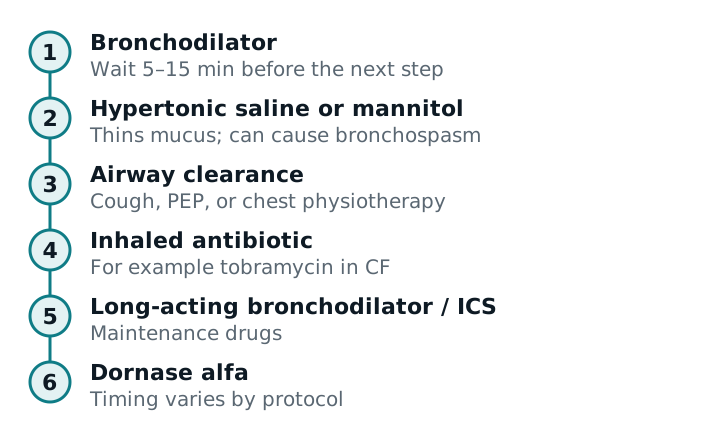
There is no single national rule, but the logic is consistent. Give the bronchodilator first because it opens the airways and blunts the bronchospasm that hypertonic saline or acetylcysteine can trigger. Then give mucoactive drugs and do airway clearance, and give the inhaled antibiotic and the controller drugs after the airways are clearer.
Study example
A teenager with CF has a bronchodilator, hypertonic saline, tobramycin, and airway clearance ordered together. You give the albuterol first and wait. After the hypertonic saline she coughs and her breath sounds are clear, so you do airway clearance, then the tobramycin. If she wheezes during the saline, you stop, give the bronchodilator again, and tell the physician. Her ICS and long-acting bronchodilator wait until the end, and she rinses and spits after the ICS.
See bronchodilators, chest physiotherapy devices, and asthma.
Sources
- FDA label. Flovent HFA (fluticasone propionate) inhalation aerosol. DailyMed.
- FDA label. Singulair (montelukast sodium). DailyMed.
- FDA label. Pulmozyme (dornase alfa) inhalation solution. DailyMed.
- FDA label. Acetylcysteine inhalation solution; Tobramycin inhalation solution; INOmax (nitric oxide); Curosurf (poractant alfa). DailyMed. https://dailymed.nlm.nih.gov/dailymed/lookup.cfm?setid=c90fca12-12fb-4cf6-bd6f-83bc0d95df81 and https://dailymed.nlm.nih.gov/dailymed/lookup.cfm?setid=3d044738-a715-fdee-7849-521e8981e6ec and https://dailymed.nlm.nih.gov/dailymed/lookup.cfm?setid=762b51be-1893-4cd1-9511-e645fc420d3a and
- Merck Manual Professional Edition. Persistent Pulmonary Hypertension of the Newborn (PPHN).
- Terlizzi V, et al. Hypertonic saline in people with cystic fibrosis: review of comparative studies and clinical practice. Ital J Pediatr. 2021.
- Global Initiative for Chronic Obstructive Lung Disease (GOLD). Global Strategy for Prevention, Diagnosis and Management of COPD: 2026 Report.