Asthma: exacerbations and ventilating the severe attack
Severity signs and PEF, why a normal PaCO2 is a warning, ED drugs, and how to ventilate a severe asthmatic without trapping air.
- Severe attack: PEF< 50% of bestPersonal best or predicted
- Severe attack: SpO2< 92%On room air
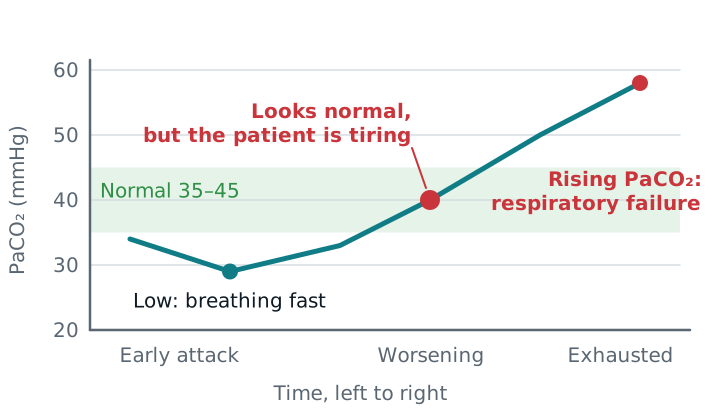
- ABG, early attackPaCO2 < 40A normal or rising value means fatigue
- Ventilator rate12–14 /minLow rate, I:E of about 1:4 to 1:5
Asthma is airway inflammation with reversible airflow obstruction: the airway muscle tightens, the lining swells, and mucus plugs the small airways. Between attacks the lungs can be normal. In an exacerbation, air gets in but can’t get out, so the lungs fill up with trapped gas. The RT’s job is to size up severity quickly, deliver bronchodilators, and recognize the patient who is wearing out.
How an attack looks
A classic acute attack shows hyperinflation, accessory muscle use, prolonged expiration, and inspiratory and expiratory wheezes. GINA grades the attack in adults and children 6 and older:
| Severity | What you see | Lung function |
|---|---|---|
| Mild | Talks in sentences, can lie down, SpO2 94% or more | PEF or FEV1 above 70% of best or predicted |
| Moderate | Talks in phrases, prefers sitting, uses accessory muscles, SpO2 92% or more | 50 to 70% |
| Severe | Can’t speak, drink, or lie down; respiratory rate above 30; SpO2 below 92%; silent chest | Below 50% |
| Life-threatening | Drowsy, confused, cyanosis, or quiet chest |
Peak expiratory flow (PEF) is judged against the patient’s personal best, not just a table. A silent chest is not a sign the patient is better: so little air is moving that there is nothing to hear.
The ABG tells a story
GINA says PaCO2 is often below 40 mmHg during an exacerbation, because the patient is breathing fast. Fatigue and sleepiness suggest the PaCO2 may be climbing. A PaO2 under 60 with a normal or high PaCO2 (especially above 45) means respiratory failure. GINA suggests an ABG when PEF or FEV1 is under 50% of predicted or the patient is not responding.
Treatment in the ED
GINA’s emergency flow chart, for patients 6 and older:
- Oxygen to an SpO2 of 92 to 95%.
- Albuterol (salbutamol) by MDI with a spacer or by nebulizer, repeated every 20 to 30 minutes for up to three doses. See MDI technique.
- Ipratropium added for moderate to severe attacks; it reduced admissions and improved lung function compared with the beta2-agonist alone in adults.
- Systemic corticosteroids started within an hour. Adult courses of 5 to 7 days work as well as 10 to 14.
- IV magnesium sulfate considered for a severe or worsening attack.
- Avoid sedatives. GINA says sedation must be strictly avoided because it depresses breathing.
The evidence for NIV in severe asthma is weak and GINA offers no recommendation for or against; if it is tried, monitor closely and don’t use it in an agitated patient. The US NAEPP 2020 update revised six topics in the 2007 guidelines; the acute-care steps above are GINA’s.
Ventilating a severe asthmatic
If the patient is intubated, the problem is dynamic hyperinflation: each breath starts before the last one is out, so gas stacks up, auto-PEEP rises, and venous return and blood pressure fall. A 2024 review recommends:
- Low minute ventilation, with a rate around 12 to 14 breaths/min and an I:E ratio of about 1:4 to 1:5. Cutting the rate is the most effective way to lengthen expiration.
- Accept a high PaCO2 (permissive hypercapnia). The review says pH as low as 7.20 is probably tolerable, as in ARDS.
- Watch plateau pressure and auto-PEEP, using an inspiratory hold and an expiratory hold. If the patient suddenly gets worse, think of a pneumothorax. See ventilator graphics.
Study example
A 24-year-old can say only two words at a time, with a respiratory rate of 34 and SpO2 90% on room air. PEF is 40% of personal best. This is a severe attack. You start oxygen, albuterol and ipratropium, and the team gives steroids. Thirty minutes later the patient is quieter, the chest sounds tight, and the ABG shows PaCO2 42 mmHg. That number would be normal in a calm patient, but here it means fatigue, so you stay at the bedside and call for help.
Related: COPD, spirometry, ABG interpretation, pneumothorax.
See dynamic hyperinflation happen on the asthma patient in the ventilator simulator.
Sources
- Global Initiative for Asthma (GINA). Global Strategy for Asthma Management and Prevention, 2026 report: Section 9, management of exacerbations (Box 9-6).
- National Asthma Education and Prevention Program Coordinating Committee Expert Panel Working Group. 2020 Focused Updates to the Asthma Management Guidelines. NHLBI.
- Critical Care Management of Severe Asthma Exacerbations. J Clin Med. 2024.
- Murray and Nadel's Textbook of Respiratory Medicine: History and Physical Examination (Table 16-3).