Study notesNeonatal and pediatric
Neonatal respiratory disorders: RDS, TTN, MAS, PPHN, BPD
How to tell respiratory distress syndrome, transient tachypnea, meconium aspiration, apnea of prematurity, BPD, and PPHN apart, and how each is treated.
- RDS causeSurfactant lackRisk rises below 34–36 weeks
- TTN course2–3 daysDelayed fetal lung fluid clearance
- Apnea of prematurityPause > 20 sOr shorter with HR < 100; treat with caffeine
- PPHN cluePostductal SpO2 ≥ 5% lowerThan preductal (right hand)
- Inhaled NO (PPHN)20 ppmStart dose, then titrate
A newborn in distress shows the same signs whatever the cause: grunting, nasal flaring, retractions, fast breathing, and cyanosis. The history (gestational age, delivery, meconium) and the chest X-ray tell the causes apart. Use this page to match a case to its disorder.
Respiratory distress syndrome (RDS)
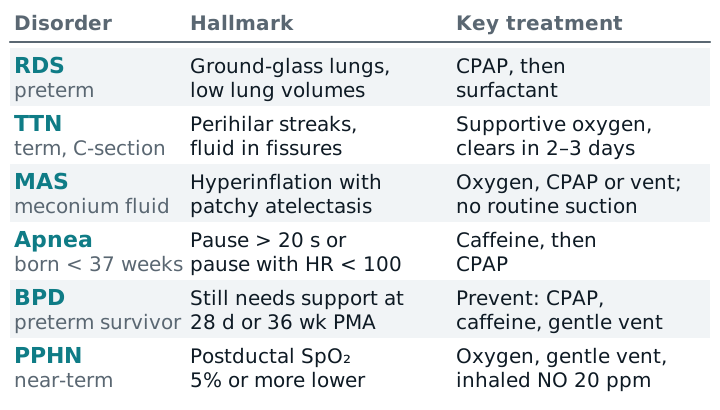
Cause: too little surfactant. Without it the alveoli collapse, the lungs become atelectatic, and compliance falls. It mostly affects premature infants because surfactant is made in adequate amounts only after about 34–36 weeks. The X-ray shows a ground-glass appearance with air bronchograms and low lung volumes.
Treatment: noninvasive support first. Nasal CPAP (or NIPPV) lowers the risk of death and BPD compared with intubation. Give surfactant into the airway when it is indicated, often by a less-invasive method, and early selective dosing (within 1–2 hours in infants with RDS signs) is favored over routine prophylaxis. If the baby is ventilated, lower the pressure and FiO2 quickly as compliance improves, to limit air leak. Antenatal steroids to the mother before delivery under 34 weeks reduce RDS. Without complications it resolves in about 4–5 days.
Transient tachypnea of the newborn (TTN)
Cause: delayed clearance of fetal lung fluid. It is typical in term babies born by cesarean without labor and in late preterm infants. The X-ray shows streaky perihilar markings (a “shaggy heart border”), fluid in the fissures, and normal or large lung volumes.
Treatment: supportive oxygen, occasionally CPAP. It usually clears in 2–3 days.
Meconium aspiration syndrome (MAS)
Cause: inhaling meconium-stained fluid around birth, causing airway obstruction, inflammation, and surfactant inactivation. Partial plugging traps air, so hyperinflation with patchy atelectasis is typical, and there is a high risk of pneumothorax and PPHN.
Current stance on suctioning: routine suctioning of the mouth, nose, or trachea is not recommended, whether or not the fluid is stained. The 2025 AHA/AAP guideline rates it as no benefit. Suction only when the airway looks obstructed and ventilation is not working. Treatment: oxygen, CPAP or ventilation, sometimes surfactant, inhaled nitric oxide for refractory hypoxemia, and ECMO if needed. If an intubated infant suddenly worsens, look for an air leak.
Apnea of prematurity
A pause in breathing longer than 20 seconds, or a shorter pause with bradycardia below 100, in an infant born before 37 weeks with no other cause. Most is central (immature brainstem control); some is obstructive (neck flexion, blocked nose) or mixed. Caffeine is the safest and most common drug. If apnea continues, use CPAP, and ventilation for severe episodes. Nearly all babies outgrow it by about 40 weeks postmenstrual age.
Bronchopulmonary dysplasia (BPD)
Chronic lung disease of prematurity: the infant still needs oxygen or respiratory support at 28 days or 36 weeks postmenstrual age. Prolonged ventilation, high oxygen, infection, and prematurity injure the developing lungs, and the alveoli end up fewer and larger. Prevention is the point: antenatal steroids, early CPAP instead of intubation, selective surfactant, caffeine, volume-targeted ventilation, and permissive hypercapnia (pH above 7.25). Keep SpO2 at 89% or higher and watch for pulmonary hypertension.
Persistent pulmonary hypertension of the newborn (PPHN)
Cause: pulmonary vascular resistance stays high after birth, so blood shunts right to left through the ductus arteriosus and foramen ovale. It often follows MAS, RDS, or sepsis. The baby has labile hypoxemia that does not improve with 100% oxygen. An SpO2 on the lower body (postductal) that is 5% or more below the right hand or ear (preductal) points to a ductal shunt, and an echocardiogram confirms it.
Treatment: oxygen as a pulmonary vasodilator (start at FiO2 1.0, then titrate to a PaO2 of 50–90 mmHg), gentle ventilation, and inhaled nitric oxide at 20 ppm, labeled for term and near-term infants (over 34 weeks) with hypoxic respiratory failure and pulmonary hypertension. ECMO is for refractory cases. See oxygen therapy.
Study example
A 29-week infant has grunting and retractions at 20 minutes of age, with low lung volumes and a ground-glass chest film. You set up CPAP and the physician gives surfactant through a thin catheter. At 4 days the infant is on room air. Compare a term baby delivered by planned cesarean who is breathing at 70 per minute with a streaky film and who is on room air by day 2: that is TTN.
See neonatal assessment and resuscitation and inhaled drugs.
Sources
- Merck Manual Professional Edition. Respiratory Distress Syndrome in Neonates.
- Merck Manual Professional Edition. Transient Tachypnea of the Newborn; Meconium Aspiration Syndrome; Persistent Pulmonary Hypertension of the Newborn (PPHN). https://www.merckmanuals.com/professional/pediatrics/respiratory-problems-in-neonates/transient-tachypnea-of-the-newborn and https://www.merckmanuals.com/professional/pediatrics/respiratory-problems-in-neonates/meconium-aspiration-syndrome and
- Merck Manual Professional Edition. Apnea of Prematurity; Bronchopulmonary Dysplasia (BPD). https://www.merckmanuals.com/professional/pediatrics/respiratory-problems-in-neonates/apnea-of-prematurity and
- FDA label. INOmax (nitric oxide) gas. DailyMed.
- Kuitunen I, Davis PG. How consistent are recent neonatal resuscitation guidelines? Resusc Plus. 2026;29:101314.