Bronchodilators: SABA, LABA, SAMA, LAMA
The main bronchodilator classes, how each works, onset and duration, side effects, and why a LABA is never used alone in asthma.
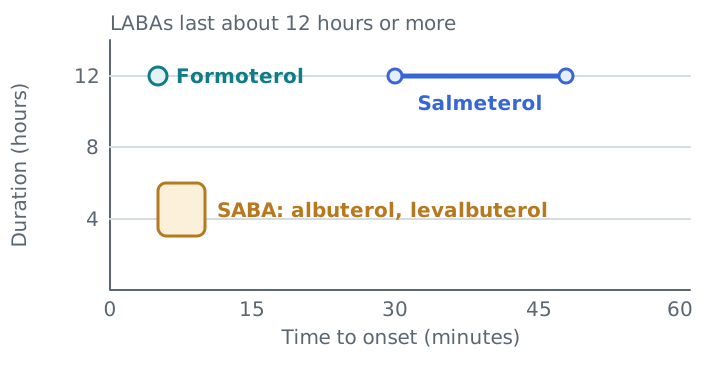
- Albuterol onset / duration~5 min / 4–6 hRescue drug (FDA label)
- LABA duration12 h or moreMaintenance, not rescue
- LABA in asthmaNever aloneAlways with an inhaled corticosteroid
- Beta-agonist side effectsTremor, tachycardiaAlso hypokalemia
- Anticholinergic side effectDry mouthMain effect of inhaled agents
Bronchodilators open narrowed airways by relaxing airway smooth muscle. There are two main families, the beta2-agonists and the anticholinergics (antimuscarinics), and each comes in a short-acting and a long-acting form. As an RT you pick the device, teach the technique, and watch for side effects, so you need to know which drug is the rescue and which is the maintenance.
The classes at a glance
| Class | Examples | How it works | Onset and duration | Typical use |
|---|---|---|---|---|
| SABA (short-acting beta2-agonist) | albuterol, levalbuterol | Stimulates beta2 receptors, which raises cyclic AMP and relaxes smooth muscle | Onset about 5 minutes; lasts about 4 hours, up to 6 | Rescue; first bronchodilator in an acute episode |
| LABA (long-acting beta2-agonist) | salmeterol, formoterol, vilanterol, indacaterol, olodaterol | Same mechanism, longer binding | Formoterol onset ~5 min; salmeterol 30–48 min; both ≥ 12 h; vilanterol, indacaterol, and olodaterol once daily | Maintenance |
| SAMA (short-acting muscarinic antagonist) | ipratropium | Blocks M3 muscarinic receptors so acetylcholine cannot constrict the airway | Short-acting; dosed 4 times daily | Added to a SABA in COPD or severe asthma episodes |
| LAMA (long-acting muscarinic antagonist) | tiotropium, umeclidinium, aclidinium, glycopyrrolate, revefenacin | Binds M3 receptors for a long time | Tiotropium, umeclidinium, revefenacin once daily; aclidinium twice daily | COPD maintenance |
Levalbuterol is the R-isomer of albuterol. Its label reports onset in about 5.5–10 minutes and a median duration of 3–4 hours (up to 6 in some patients), so in practice it behaves like albuterol.
Methylxanthines such as theophylline are non-selective phosphodiesterase inhibitors. Their exact action is debated, and many drugs and age change how fast the body clears them, so doses are individualized and blood levels followed. GOLD does not recommend them for COPD exacerbations.
Side effects
- Beta2-agonists: resting tachycardia and possible arrhythmias, tremor (more often at higher doses), hypokalemia (usually mild and short-lived, more likely with thiazide diuretics), and sometimes a small fall in PaO2. Rarely, paradoxical bronchospasm: the airways tighten right after the dose, and you must stop the drug.
- Anticholinergics: dry mouth is the main one. Ipratropium can leave a bitter, metallic taste. Poor absorption keeps systemic effects low. Mist from an anticholinergic solution used with a face mask can reach the eyes and has set off acute glaucoma, so protect the eyes. LAMAs can also cause constipation, blurred vision, and urinary retention in some patients.
Using them by condition
- Asthma: a SABA relieves symptoms, and a LABA is added to an inhaled corticosteroid for control. See asthma and inhaled steroids.
- COPD: SABA (with or without a SAMA) first for symptoms and exacerbations, then long-acting maintenance with a LABA, a LAMA, or both. LAMAs reduce exacerbations. See COPD.
- Technique matters: the best drug fails with a poor technique. See MDI technique, DPI technique, and small-volume nebulizer setup.
Study example
A COPD patient on tiotropium once daily says his hands shake and his heart pounds after three albuterol treatments in two hours. That fits beta2 side effects. You check his heart rate and, if the order allows it, a potassium level, then tell the physician rather than adding doses. His dry mouth is more likely from the tiotropium and is not dangerous. You also check his inhaler technique.
See COPD, asthma, and MDI technique.
Sources
- Global Initiative for Chronic Obstructive Lung Disease (GOLD). Global Strategy for Prevention, Diagnosis and Management of COPD: 2026 Report. Bronchodilator appendix.
- FDA label. Ventolin HFA (albuterol sulfate) inhalation aerosol. DailyMed.
- FDA label. Xopenex HFA (levalbuterol tartrate) inhalation aerosol. DailyMed.
- FDA label. Serevent Diskus (salmeterol xinafoate). DailyMed.
- FDA label. Foradil Aerolizer (formoterol fumarate). DailyMed.
- FDA label. Atrovent HFA (ipratropium bromide) and Spiriva HandiHaler (tiotropium bromide). DailyMed. https://dailymed.nlm.nih.gov/dailymed/lookup.cfm?setid=170e98ef-5560-4068-be7d-e649068eb884 and