Smoke inhalation and carbon monoxide poisoning
Why SpO2 reads falsely normal in CO poisoning, how COHb is measured, how oxygen shortens its half-life, and when to worry about the airway and cyanide.
- CO affinity for Hb~200× O2Shifts the curve left and cuts O2 content
- COHb half-life, room air~320 minAbout 4–6 hours
- COHb half-life, 100% O2< 90 minUsually quoted as 60–90 minutes
- COHb half-life, 3 ATA~23 minHyperbaric oxygen
Carbon monoxide (CO) is a colorless, odorless gas made by incomplete burning. It is the leading hidden danger in house fires, faulty heaters, and car exhaust. Smoke inhalation adds airway burns and other toxic gases. For the RT, the key idea is that CO poisoning hides from the pulse oximeter.
What CO does
CO binds to hemoglobin about 200 times more tightly than oxygen does. It forms carboxyhemoglobin (COHb), which can’t carry oxygen. It also shifts the oxyhemoglobin curve left, so the oxygen that is bound is released poorly. The result is tissue hypoxia even when the PaO2 is normal.
Pulse oximetry cannot tell COHb from oxyhemoglobin. The SpO2 can read normal while the patient is severely poisoned, so don’t use it to rule out hypoxia. The tests that work are co-oximetry on an arterial or venous blood gas sample, which measures COHb directly, and a CO-oximetry pulse oximeter that estimates COHb. See pulse oximetry and ABG interpretation.
How the patient looks
Early symptoms are headache, dizziness, fatigue, nausea, and shortness of breath. Higher levels bring confusion, trouble with balance, fainting, seizures, chest pain or ECG changes, and coma. A published table links 15 to 25% COHb with mild symptoms, 25 to 40% with moderate to severe symptoms, and above 50% with life-threatening illness, but the same position statement notes that, in 1,323 patients, COHb didn’t track the clinical picture reliably. Smokers carry a higher baseline, and a short, heavy exposure can cause serious neurologic or cardiac problems at a modest level. Treat the patient and the history, not the number.
Treatment
- Remove the patient from the source and start life support if needed.
- Give the highest oxygen concentration you can, without waiting for a lab result: a tight-fitting non-rebreather with enough flow to keep the bag from collapsing (usually 10 to 15 L/min), or FiO2 1.0 on the ventilator. Intubate and ventilate a patient who can’t protect the airway or is unconscious.
- Continue oxygen for as long as your protocol and the physician direct, and recheck COHb.
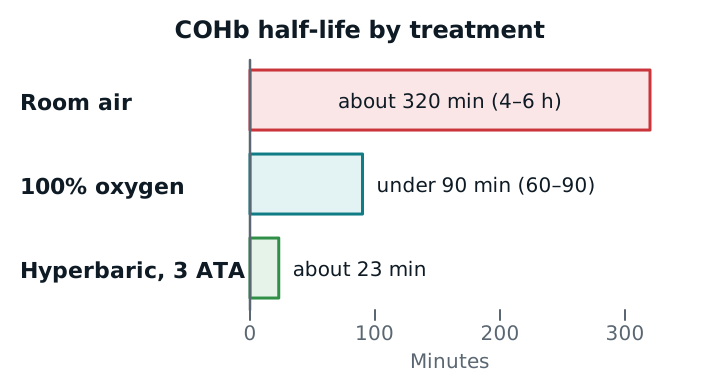
Oxygen works by competing with CO. It shortens the half-life of COHb from about 320 minutes (4 to 6 hours) on room air to under 90 minutes (often quoted as 60 to 90), and to about 23 minutes in a hyperbaric chamber at 3 atmospheres absolute (ATA).
Hyperbaric oxygen is considered in selected patients, mainly those with neurologic or cardiac symptoms, or metabolic acidosis, that persist despite 100% oxygen, regardless of the COHb level. The Polish position statement says it is always indicated in pregnancy, and that the first session should ideally be within 6 hours of exposure. Local rules differ, so follow your protocol and the toxicologist or hyperbaric physician.
Smoke inhalation: the airway
Heat and soot injure the upper airway, which can swell shut over hours. Clues are facial burns, singed nasal hairs, soot in the mouth or nose or airway, carbonaceous (black) sputum, and a change in voice. If the history and exam suggest significant thermal injury to the upper airway, consider intubation early for airway protection, before swelling makes it hard. Bronchoscopy within 24 hours can grade the injury.
Cyanide
Burning plastics and other materials can release cyanide, which also blocks the use of oxygen. Suspect it in a patient with significant smoke exposure who is sicker than the COHb level explains. Hydroxocobalamin is the antidote used in the smoke-inhalation studies; most patients received 5 or 10 g IV, and expected effects are red urine and skin discoloration. The physician orders it; you help by recognizing the setting and getting early lab work.
Study example
A firefighter is dizzy and nauseated after a basement fire. His SpO2 is 99% on room air, but a blood gas co-oximeter reads COHb 22%. You place him on a non-rebreather at 15 L/min. You check his airway and voice, since he has soot around his nostrils, and tell the physician about the soot. On room air, half the COHb would take about 5 hours to clear; on 100% oxygen, about an hour to an hour and a half.
Related: pulse oximetry, oxygen masks, ARDS.
Sources
- Management of acute intoxication with carbon monoxide: position statement of the Polish Medical Society, Section of Clinical Toxicology. Int J Occup Med Environ Health. 2025.
- Inhalation injury: epidemiology, pathology, treatment strategies. Scand J Trauma Resusc Emerg Med. 2013.
- Intravenous Hydroxocobalamin for Cyanide Poisoning From Smoke Inhalation: A Comprehensive Scoping Review. J Am Coll Emerg Physicians Open. 2026.