Tracheostomy care and speaking valves
Parts of a trach tube, cuffed versus fenestrated tubes, why a speaking valve needs a fully deflated cuff, daily care, and accidental decannulation.
- Cuff pressure20–30 cm H2OCuffed tube; use a manometer
- Speaking valveCuff fully deflatedNever with the cuff inflated
- Fresh stoma< 7 daysDo not blindly reinsert; call for help
A tracheostomy is an opening in the front of the neck into the trachea, kept open by a tube. RTs suction it, manage the cuff, set up humidity, troubleshoot the ventilator, and respond when the tube comes out. Humidified oxygen goes to the stoma through a trach collar (see humidity setup and oxygen mask types).
Parts of the tube
| Part | What it does |
|---|---|
| Outer cannula | The curved tube that holds the airway open |
| Inner cannula | A removable liner that locks into the outer cannula. It can be taken out and cleaned or replaced if secretions build up. |
| Obturator | A rounded introducer placed in the outer cannula to guide it in. Remove it once the tube is in place. Keep it at the bedside. |
| Flange (neck plate) | The wings that rest on the skin. Ties or a holder attach here. |
| Cuff and pilot balloon | A balloon near the tip that seals against the trachea. The pilot balloon outside the neck tells you if the cuff is full. |
| 15 mm connector | The hub where the ventilator, a T-piece, or a speaking valve attaches |
An inner cannula narrows the airway. On a bench it raised resistance about two- to threefold, which matters in a patient who is breathing without support.
Cuffed, uncuffed, and fenestrated
- Cuffed: seals the airway for positive-pressure ventilation and reduces aspiration of secretions. Keep cuff pressure at 20–30 cm H2O: below 20 risks aspiration, above 30 risks mucosal injury.
- Uncuffed: used for patients who don’t need a seal, and as part of weaning.
- Fenestrated: has an opening in the outer curve so some exhaled air can go up through the larynx for speech. It needs the cuff deflated. Evidence is limited, and one series reported granulation tissue in many patients, so these are used selectively.
The speaking valve
A one-way speaking valve attaches to the hub. Air comes in through the valve on inhalation. On exhalation the valve closes and all exhaled air must leave through the mouth and nose, past the vocal cords, so the patient can talk.
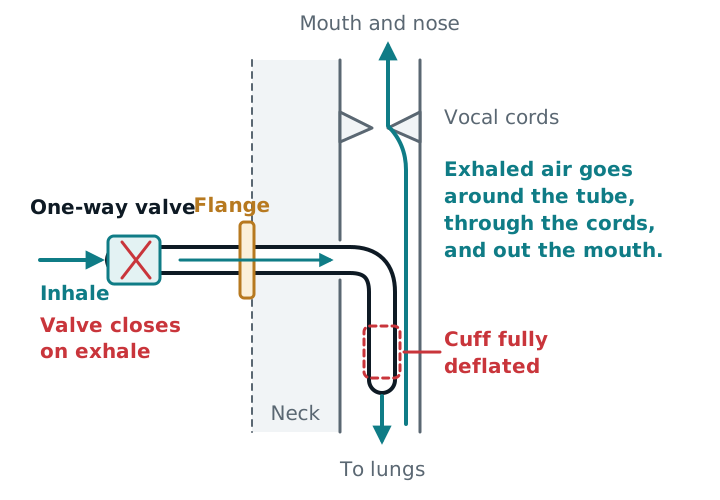
In the studies reviewed, a valve with a deflated cuff also helped swallowing and weaning. It sends air through the upper airway, which can dry the mucosa, so watch secretions and humidity during long sessions.
Daily care
- Stoma care at least daily. A recent consensus suggests mild soap, saline, or water, not antiseptics. A foam dressing around the stoma and under the ties lowers pressure injury; hydrophilic dressings cut injury by more than half in one meta-analysis cited by the AARC.
- Check the skin under the flange and the ties each shift.
- Inner cannula: clean or replace on your facility’s schedule. The evidence doesn’t set a frequency.
- Cuff pressure with a manometer; don’t judge by feel.
- Suction as needed (airway suctioning).
- The AARC adult guideline supports tracheostomy bundles, a multidisciplinary team, and a weaning and decannulation protocol, which shorten time to decannulation.
Accidental decannulation
Keep at the bedside: a spare tube of the same size and one one size smaller, an obturator, a syringe, lubricant, suction, a bag-valve-mask that fits a face mask and the trach, and oxygen.
- Fresh stoma (less than about 7 days): the tract may not be mature, and a blind reinsertion can create a false passage. Do not reinsert. Call for help. If the patient is ventilated, cover the stoma and bag by mouth and nose.
- Mature stoma (more than 7 days): a trained clinician can reinsert the same-size tube with the obturator, or the smaller one if it won’t pass. Remove the obturator, inflate the cuff, suction through the tube, listen to both sides, then reconnect the ventilator.
The 7-day line comes from one hospital’s protocol; follow your own facility’s policy.
Study example
A patient two weeks after tracheostomy is off the ventilator with a cuffed tube. The cuff is deflated with a syringe, and you place a one-way valve on the hub. She speaks. A minute later she coughs and is struggling to exhale. You remove the valve at once, check that the cuff was in fact down (the pilot balloon was still firm), and deflate it fully before trying again.
See airway suctioning, humidity setup, ventilator alarms, and oxygen mask types.
Sources
- Medrinal C, Delemazure J, et al. Expert consensus-based clinical practice guidelines for care and weaning procedures in tracheostomized ICU patients after invasive mechanical ventilation (SKR/SRLF joint statement). Ann Intensive Care. 2026.
- Mussa CC, et al. AARC Clinical Practice Guideline: Management of adult patients with tracheostomy in the acute care setting. Respir Care. 2021;66(1):156-169.
- Goodfellow LT, et al. AARC Clinical Practice Guideline: Patient-ventilator assessment. Respir Care. 2024;69(8):1042-1054.
- Austin Health. Emergency response to accidental tracheostomy decannulation (hospital protocol, 2020).