Study notesMechanical ventilation
Ventilator liberation and the SBT
Screen daily, pair sedation breaks with a spontaneous breathing trial, know the failure signs, and support high-risk patients after extubation.
- SBT length30–120 minAARC 2024 guideline definition
- Pressure supportUp to 8 cm H2OLow-level PS is acceptable
- RSBI cutoff (older)< 105Breaths/min/L; AARC says not required
- SBT failureRR > 35, SpO2 < 90%ARDSNet criteria
Liberation means taking a patient off invasive ventilation. Extubation is removing the tube. They are not the same: a patient can pass a trial and still fail extubation because of weak cough or heavy secretions. The aim is to find the first day the patient can breathe, not to wait for a perfect day.
Daily readiness screen
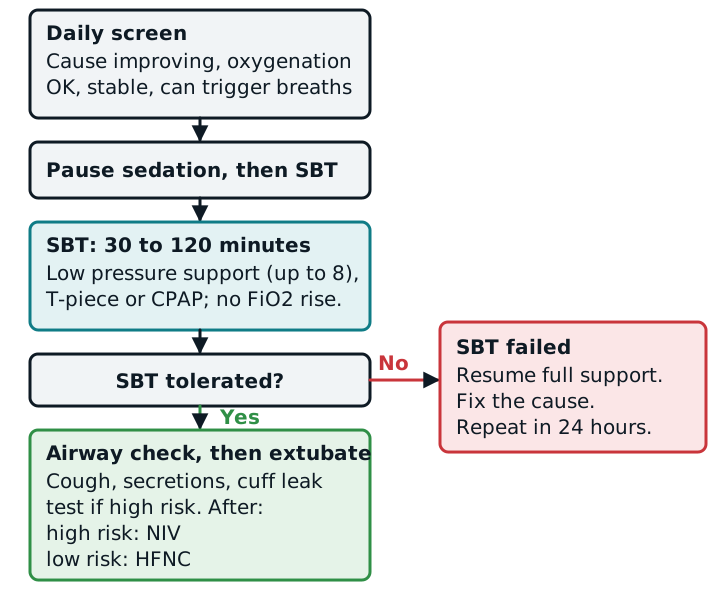
A simple screen is enough, according to the AARC: some reversal of the cause of respiratory failure, adequate oxygenation, hemodynamic stability, and the ability to start a breath. The ARDSNet protocol puts numbers on it: FiO2 ≤ 0.40 with PEEP ≤ 8, systolic blood pressure ≥ 90 mmHg without vasopressors, no neuromuscular blockade, and acceptable spontaneous effort.
Pair it with a sedation break. The AARC guideline describes spontaneous awakening trials coordinated with SBTs, and the ATS/ACCP guideline recommends protocols that minimize sedation. Do the screen and SBT each morning (the AARC suggests before noon).
The SBT
An SBT is a period of breathing with little or no ventilator help, usually 30–120 minutes.
- The ATS/ACCP 2017 guideline suggests starting with inspiratory pressure augmentation of 5–8 cm H2O rather than a T-piece or CPAP.
- The AARC 2024 guideline says an SBT can be done with or without low-level pressure support (up to 8). It also suggests not raising FiO2 during the trial.
- Pressure support 0 and PEEP 0 on the ventilator is often used as a stand-in for a T-piece and keeps monitoring on.
Signs of failure (ARDSNet criteria): SpO2 below 90%, spontaneous tidal volume below 4 mL/kg PBW, respiratory rate above 35/min, pH below 7.30, or distress: heart rate more than 120% of baseline, marked accessory muscle use, abdominal paradox, sweating, or marked dyspnea. If the trial fails, return to a stable, comfortable level of support, find the cause, and repeat in 24 hours.
RSBI
The rapid shallow breathing index is breathing frequency divided by tidal volume in liters, taken in the first minute or so off the ventilator. Older teaching says below 105 breaths/min/L predicts success. The AARC 2024 guideline suggests RSBI is not needed to decide whether a patient is ready for an SBT (conditional recommendation). It may delay a trial that would have succeeded. You may still see it in course material.
Before and after extubation
- Cuff leak test for patients at high risk of stridor: deflate the cuff and look for a leak around the tube. A quantitative leak below about 110 mL is a commonly used cutoff. A systematic review found the test only moderately sensitive (0.62) but fairly specific (0.87). If it fails and the patient is otherwise ready, give systemic steroids at least 4 hours before extubation (ATS/ACCP).
- Airway protection: check cough strength and secretion load. These cause reintubation even after a passed SBT.
- High-risk patients (for example COPD) who passed an SBT after more than 24 hours of ventilation should be extubated to preventive NIV. The 2026 ATS guideline gives a risk-based suggestion: HFNC for low-risk patients and NIV for high-risk patients. The AARC notes that post-extubation NIV is anecdotally set near PS 5–8 and PEEP 5 cm H2O.
Study example
A COPD patient (PBW 64 kg) has been ventilated for 3 days. FiO2 is 0.35 and PEEP is 5, and blood pressure is stable without pressors. After the sedation break, he starts a 30-minute SBT at PS 5 and PEEP 5. At 20 minutes his RR is 24, SpO2 is 94%, and tidal volume is 380 mL (5.9 mL/kg PBW). He passes. Because he has COPD and was ventilated more than 24 hours, the plan is extubation to NIV, with a cuff leak test first if the team is concerned about stridor.
See noninvasive ventilation, HFNC, ventilator modes, and COPD.
Sources
- Roberts KJ, et al. AARC Clinical Practice Guideline: Spontaneous breathing trials for liberation from adult mechanical ventilation. Respir Care. 2024.
- Fan E, et al. Liberation from mechanical ventilation in critically ill adults: an official ATS/ACCP clinical practice guideline. Ann Am Thorac Soc. 2017;14(3):441-443.
- ARDS Network (NIH NHLBI). Mechanical ventilation protocol summary (readiness and SBT tolerance criteria).
- Goel NN, et al. Noninvasive respiratory support for adult patients with acute respiratory failure: an official ATS Clinical Practice Guideline. Am J Respir Crit Care Med. 2026;212(9):2135-2158.
- Kuriyama A, Jackson JL, Kamei J. Performance of the cuff leak test in adults in predicting post-extubation airway complications: a systematic review and meta-analysis. Crit Care. 2020.
- Karthika M, et al. Rapid shallow breathing index. Ann Thorac Med. 2016.