Breath sounds: normal, adventitious, and absent
Normal breath sounds by location, plus crackles, wheezes, rhonchi, stridor, and pleural rub: when in the breath you hear each and what it suggests.
- WheezeContinuous, high-pitchedUsually expiratory; airway narrowing
- Fine cracklesLate inspiratoryInterstitial disease, early heart failure
- StridorInspiratoryUpper airway obstruction; urgent
- Bronchial sound over lungConsolidationNormal only over the trachea and large airways
Lung sound player
Tap a sound. Tap another to switch mid-breath. Headphones help.
Breath sounds
Added (adventitious) sounds
Listen to a few breaths, then pick a tile. The scope shows when the patient breathes in and out, but not the sound. After you answer, tap any tile to compare.
- Sounds like
- When
- Means
- Listen for
These are synthesized teaching sounds, built from the pitch, timing, and duration that define each one, so they are cleaner than real patients. Real chests add heart sounds, rustle, and several sounds at once. Laptop and phone speakers drop the low notes; use headphones.
Breath sounds tell you where air is moving and what it is moving through. Learn the normal sounds and where they belong first. An abnormal sound is easier to spot, and its location and timing narrow the cause. The player above lets you hear each one and switch between them mid-breath; its quiz mode tests your ear.
Technique
Use the diaphragm of the stethoscope on bare skin. Ask the patient to breathe deeply through an open mouth, and compare side with side at each level, working down the back and across the front. Listen to a full breath at every spot, then ask what you heard in inspiration versus expiration.
Normal breath sounds
| Sound | What it is like | Where it is normal |
|---|---|---|
| Vesicular | Soft, low-pitched, rustling. Inspiration is longer than expiration, with no pause. | Most of the peripheral lung |
| Bronchovesicular | Medium pitch. Inspiration and expiration about equal. | Front, over the first and second intercostal spaces; back, between the shoulder blades |
| Bronchial | Loud, hollow, high-pitched. A pause between phases; expiration as long as or longer than inspiration. | Over the manubrium and large airways |
| Tracheal | Harsh and very loud. | Over the trachea in the neck |
A bronchial sound heard over the periphery of the lung is abnormal. Solid or fluid-filled lung conducts sound from the large airways better than normal air-filled lung does, so it suggests consolidation.
Adventitious sounds
These are extra sounds added to the breath. The standard grouping follows the American Thoracic Society and the International Lung Sound Association: crackles are discontinuous, and wheezes and rhonchi are continuous (longer than about 250 ms). Crackles were once called rales.
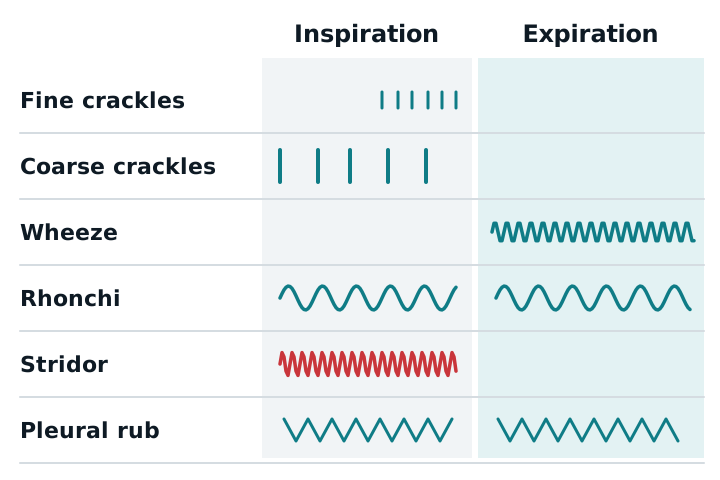
| Sound | Character | Timing | Think of |
|---|---|---|---|
| Fine crackles | Short, high-pitched, popping | Late inspiratory | Interstitial lung disease (a “Velcro” sound in pulmonary fibrosis), early heart failure |
| Coarse crackles | Longer, lower, bubbling | Early inspiratory, often also expiratory | Chronic bronchitis, bronchiectasis, severe pulmonary edema, secretions |
| Wheeze | High-pitched, musical (dominant frequency 400 Hz or more) | Mostly expiratory; can be inspiratory | Asthma and COPD when widespread; one spot suggests a foreign body, mucus plug, or tumor |
| Rhonchi | Low-pitched, snoring (about 200 Hz or less) | Either phase | Secretions in larger airways, as in chronic bronchitis |
| Stridor | Loud, high-pitched, best heard over the neck | Mainly inspiratory | Upper airway obstruction: edema, a foreign body, vocal cord problems |
| Pleural rub | Grating or leathery | Both phases | Inflamed pleura: pleurisy, pleural infection |
Crackles are thought to be the sound of small airways and alveoli popping open, so they follow atelectasis, fluid in the alveoli, and interstitial disease.
Diminished or absent breath sounds
Quiet breath sounds mean little air is reaching the stethoscope. Causes include severe airflow limitation (asthma, COPD), pleural effusion, pneumothorax, a blocked airway, and a thick chest wall. Check a unilateral loss against the trachea and percussion note (physical assessment): dull and quiet fits fluid, hyperresonant and quiet fits air.
Study example
After a coughing spell, a patient with chronic bronchitis has coarse crackles early in inspiration and low-pitched snoring sounds that you can hear in both phases. Both are secretion sounds. You suction or have the patient cough, then listen again. If the sounds clear, secretions were the cause. A wheeze that stays in one spot after coughing deserves a closer look for a plug or a foreign body.
Related: physical assessment, chest X-ray basics, asthma, COPD.
Sources
- Sarkar M, Madabhavi I, Niranjan N, Dogra M. Auscultation of the respiratory system. Ann Thorac Med. 2015;10(3):158-168.
- Merck Manual Professional Edition. Evaluation of the Patient With Pulmonary Issues.
- Poulin I. Respiratory System. In: Physical Assessment Essentials for Health Sciences. 2023 (CC BY 4.0).
- Kacmarek RM, Stoller JK, Heuer AJ. Egan's Fundamentals of Respiratory Care. Elsevier.