Study notesTherapeutic procedures
CPR and resuscitation: what the RT does
Adult CPR numbers from the 2025 AHA guidelines, ventilation during CPR, ETCO2 and ROSC, shockable versus non-shockable rhythms, and pediatric differences.
- Compression rate100–120 / minAdults, children, and infants
- Adult depthAbout 5–6 cm2–2.4 in; full recoil each time
- Without advanced airway30:2Pause compressions for 2 breaths
- With advanced airway1 breath / 6 sAdults, with continuous compressions
- ETCO2 during CPR< 10 mmHgPoor flow: improve compressions
Cardiac arrest care follows the 2025 AHA guidelines, which replaced the 2020 edition. The core is unchanged: fast, deep compressions with few pauses, early defibrillation for shockable rhythms, and controlled ventilation. As the RT you usually own the airway, the bag, and the capnography waveform, so your numbers need to be right.
High-quality compressions
- Rate 100–120 per minute.
- Depth about 5 cm (2 inches) in adults, not more than about 6 cm (2.4 inches). Deeper than that raises the injury rate.
- Full recoil. Do not lean on the chest between compressions.
- Minimize interruptions. Keep the compression fraction as high as possible, and at least 60%.
- Switch compressors every 2 minutes, sooner if tired. Depth falls off after a minute or two.
Ventilation during CPR
| Situation | Adult | Why |
|---|---|---|
| No advanced airway | 30 compressions : 2 breaths; pause compressions for the 2 breaths, about 1 second each | Gives oxygen without long pauses |
| Advanced airway (ETT or supraglottic) | 1 breath every 6 seconds (10 per minute), compressions never stop | Continuous compressions keep coronary perfusion up |
Do not hyperventilate. Give just enough volume to see the chest rise. Too many breaths, or too large a volume, raises intrathoracic pressure, lowers venous return, and reduces the blood flow that compressions create. Two-person bag-mask ventilation (one holds the seal, one squeezes) works better than one person doing both.
Capnography during CPR
Normal ETCO2 is 35–40 mmHg. In arrest, the CO2 reaching the lungs depends on compression-generated blood flow, so ETCO2 tells you how well the compressions are perfusing the lungs.
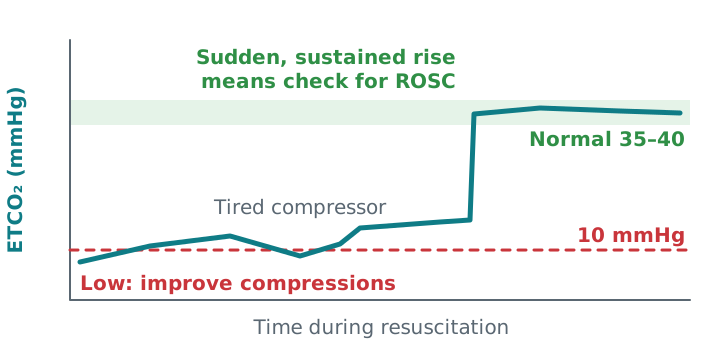
- Below 10 mmHg means poor flow: improve rate, depth, recoil, and rotate the compressor.
- A sudden, sustained rise toward the normal range suggests return of spontaneous circulation (ROSC). Check for a pulse at the next rhythm check; do not stop compressions on ETCO2 alone.
- In an intubated adult, an ETCO2 of 10 mmHg or less after 20 minutes of resuscitation predicts a very poor outcome. It is one factor in deciding when to stop, never the only one.
- A number alone should not end a resuscitation. In children, use the ETCO2 trend to judge CPR quality and do not use one cutoff to stop.
See capnography basics.
Shockable and non-shockable rhythms
| Shockable | Non-shockable | |
|---|---|---|
| Rhythms | VF (ventricular fibrillation) and pVT (pulseless ventricular tachycardia) | Asystole and PEA (pulseless electrical activity) |
| Key treatment | Defibrillation plus CPR; rhythm check every 2 minutes | CPR; find and treat the cause; epinephrine as early as possible in children |
| Shock? | Yes | Never |
Asystole and PEA are not shocked, because a shock only helps by stopping a chaotic shockable rhythm, and these rhythms are not one. Rhythm and pulse checks happen about every 2 minutes, at the same time you rotate compressors.
The RT’s role
- Open the airway, start bag-mask ventilation, and place an oral airway.
- Control the rate and volume of breaths (use a timer or feedback; 1 breath every 6 s is easy to overshoot).
- Assist with intubation or a supraglottic airway, and confirm placement with a waveform capnography trace.
- Watch ETCO2 and tell the team about the trend, especially a sudden rise.
- After ROSC, post-arrest care begins: follow your team’s targets for oxygen and CO2 and keep checking the capnography waveform.
Pediatric differences
- Rate 100–120 per minute, depth about one-third of the chest’s front-to-back diameter (about 5 cm in a child, 4 cm in an infant).
- Ratio without an advanced airway: 15:2 with two rescuers for a prepubertal child or infant, 30:2 with one rescuer at any age. Postpubertal patients use 30:2.
- With an advanced airway: continuous compressions and 1 breath every 2–3 seconds (20–30 per minute).
- Infants: use the two-thumb encircling technique, or the heel of one hand if the chest cannot be encircled. The two-finger technique is out.
- Choking: infants get 5 back blows and 5 chest thrusts; children get 5 back blows and 5 abdominal thrusts. Never use abdominal thrusts on an infant. See pediatric airway emergencies.
- Newborns follow a different algorithm; see neonatal assessment and resuscitation.
Study example
You are bagging a patient with an endotracheal tube during a code. The compressor is delivering 110 per minute and the waveform shows ETCO2 of 8 mmHg. The leader asks about quality. You report 8 mmHg, so the team switches compressors and pushes harder and faster within the correct range. Two minutes later the number is 16, then it jumps to 38 and stays there. You tell the leader, who calls for a pulse check at the next pause.
See capnography basics and endotracheal intubation.
Sources
- American Heart Association. 2025 AHA Guidelines for Cardiopulmonary Resuscitation and Emergency Cardiovascular Care (Circulation, October 2025): Part 7 Adult Basic Life Support, Part 8 Pediatric Advanced Life Support, Part 9 Adult Advanced Life Support. Part 9 abstract:
- Jang YS, et al. 2025 Korean Guidelines for Cardiopulmonary Resuscitation: Part 3. Adult basic life support. Clin Exp Emerg Med. 2026;13(Suppl 1):S18-S31.
- Kim TY, et al. 2025 Korean Guidelines for Cardiopulmonary Resuscitation: Part 4. Adult advanced life support. Clin Exp Emerg Med. 2026;13(Suppl 1):S32-S60.
- Lee JE, et al. Updated pediatric cardiopulmonary resuscitation: a comprehensive review of the 2025 guidelines. Anesth Pain Med (Seoul). 2026;21(2):150-161.