Study notesNeonatal and pediatric
Newborn transition, Apgar, and neonatal resuscitation
Fetal circulation and the shift at birth, the five-part Apgar score, newborn vital signs, and the heart-rate-driven steps of neonatal resuscitation.
- Apgar timing1 and 5 min5 signs, 0–2 points each
- Start PPVHR < 100 or apneaOr gasping; ventilation is the key step
- Start compressionsHR < 60After effective ventilation; 3:1 ratio
- Preductal SpO2 at 5 min80–85%Rises to 85–95% by 10 min
- Newborn heart rate100–170 bpmNormal range (StatPearls)
Most newborns breathe on their own within seconds, but some need help. RTs are on the team at high-risk deliveries, so you need to understand the circulation change that makes a baby pink and breathing, the Apgar score, and the order of steps in neonatal resuscitation.
Fetal circulation
Before birth the placenta does the gas exchange, and blood bypasses the fluid-filled lungs and the liver through three shunts.
- Ductus venosus: carries most of the oxygenated blood from the umbilical vein past the liver to the inferior vena cava.
- Foramen ovale: an opening between the atria that sends blood right-to-left, so it skips the lungs.
- Ductus arteriosus: connects the pulmonary artery to the descending aorta, so most right ventricle output bypasses the lungs. Low fetal PaO2 (about 25 mmHg) and prostaglandins keep it open.
At birth two things happen: the cord stops carrying blood, and the lungs fill with air. Lung expansion, more oxygen, less CO2, and nitric oxide make pulmonary vascular resistance fall, so blood flows to the lungs. Left atrial pressure rises over right atrial pressure and functionally closes the foramen ovale. The ductus arteriosus constricts over hours to days (typically within 24–72 hours), and the ductus venosus collapses. If the lungs do not open, the resistance stays high and the shunts can reopen, which is the problem in persistent pulmonary hypertension (see neonatal respiratory disorders).
Apgar score
The Apgar score rates five signs, 0, 1, or 2 points each: breathing effort, heart rate, muscle tone, reflex irritability, and color. It is scored at 1 and 5 minutes, and every 5 minutes up to 20 minutes if the 5-minute score is 7 or lower.
| Score | Meaning |
|---|---|
| 7–10 | Reassuring |
| 4–6 | Moderately abnormal |
| 0–3 | Low |
Heart rate over 100 gives 2 points, below 100 gives 1, and none gives 0. Most normal babies lose a point for blue hands and feet.
What it is not: the Apgar score is a record of how the baby is doing. It is not used to decide whether to start resuscitation. Resuscitation begins before the 1-minute score is assigned, and the heart rate, breathing, and color you see right now guide your steps. A score also shifts with gestational age and maternal medicines, and a low score does not by itself prove asphyxia.
Normal newborn values
A normal newborn heart rate is about 100–170 beats/min and systolic blood pressure about 50–90 mmHg (StatPearls). Newborns breathe faster than adults, and persistent fast breathing, grunting, flaring, or retractions suggest distress.
Neonatal resuscitation steps
The 2025 AHA/AAP guideline drives the Neonatal Resuscitation Program (NRP). The decisions follow heart rate and breathing.
- Prepare and assess: warmth, dry, position the airway, suction only if breathing seems obstructed, and stimulate. Many guidelines favor waiting at least 60 seconds to clamp the cord in vigorous newborns.
- Heart rate below 100, apnea, or gasping: start positive-pressure ventilation (PPV) and add a pulse oximeter. Rate 30–60 breaths/min, with a peak pressure around 20–30 cm H2O and PEEP of 5 cm H2O in the NRP. Check the heart-rate response after 15–30 seconds. The heart rate rise is the sign that ventilation works.
- If the heart rate does not rise: fix the ventilation first (mask seal, airway position, suction, open the mouth, increase pressure) and consider an alternative airway.
- Heart rate below 60 despite effective ventilation: begin chest compressions at the lower third of the sternum with a 3:1 compression-to-ventilation ratio (90 compressions and 30 breaths per minute), with an alternative airway and ECG monitoring. Compress about one-third of the chest’s front-to-back depth.
Initial oxygen depends on gestational age: 21% at 35 weeks or later, 21–30% at 32–34 weeks, and 30–100% below 32 weeks, titrated to the targets below.
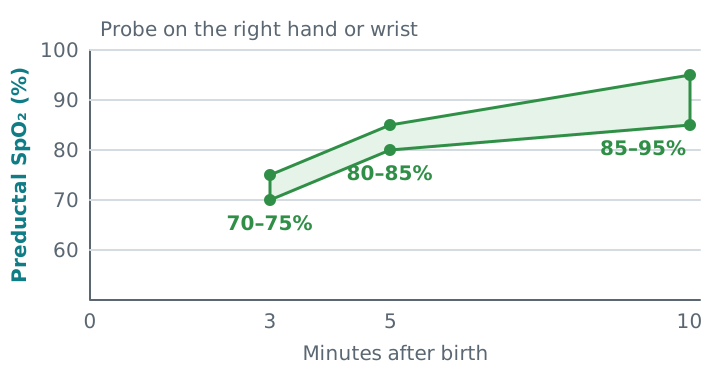
Put the probe on the right hand or wrist (preductal, before the ductus arteriosus). Very preterm infants should reach above 80% by 5 minutes.
Study example
A term newborn is limp and not breathing after drying and stimulation. You begin PPV at 40 breaths/min with a mask and room air, and place the oximeter on the right wrist. After 30 seconds the heart rate is 70 and chest rise is poor. You reposition the head, check the mask seal, and the heart rate climbs to 130, then spontaneous breathing starts. If it had stayed below 60 after effective breaths with an advanced airway, compressions at 3:1 would start.
See neonatal respiratory disorders and CPR and resuscitation.
Sources
- Trevisanuto D, Ramaswamy VV, Nimbalkar S, Weiner GM. 2025 American and European Guidelines on Neonatal Resuscitation: Concordance and Differences. Neonatology. 2026.
- Kuitunen I, Davis PG. How consistent are recent neonatal resuscitation guidelines? Resusc Plus. 2026;29:101314.
- Kong JY, et al. Singapore Neonatal Resuscitation Guidelines 2026. Singapore Med J. 2026;67(7):453-465.
- StatPearls. APGAR Score; Physiology, Neonatal. NCBI Bookshelf. https://www.ncbi.nlm.nih.gov/books/NBK470569/ and
- Merck Manual Professional Edition. Perinatal Physiology.
- StatPearls. Embryology, Fetal Circulation. NCBI Bookshelf.