Study notesNeonatal and pediatric
Pediatric airway emergencies: croup, epiglottitis, bronchiolitis, choking
Croup versus epiglottitis, what to do (and not do) for each, supportive care for bronchiolitis, choking rescue by age, and signs of respiratory distress.
- Croup age6–36 monthsBarking cough, steeple sign, usually parainfluenza
- Croup steroidDexamethasone 0.6 mg/kgOne dose
- Epiglottitis ruleDo not examine the throatSecure the airway in the OR
- Bronchiolitis oxygenKeep SpO2 > 90%Supportive care; HFNC if at risk
- Choking, infant5 back blows + 5 chest thrustsNever abdominal thrusts
Children have small airways, so a little swelling or a plugged tube can cause a lot of obstruction. You will be called for noisy breathing, so the first job is to recognize the pattern and avoid making a threatened airway worse.
Signs of respiratory distress
Watch for fast breathing, grunting, nasal flaring, and retractions (between the ribs, below the ribs, above the sternum), plus stridor or wheezing, cyanosis, and poor air entry. The mental status matters most: a child who becomes sleepy, limp, or stops fighting is tiring and nearing respiratory failure. The Westley croup score uses consciousness, cyanosis, stridor, air entry, and retractions, and a high score means impending respiratory failure.
Croup
Croup (viral laryngotracheobronchitis) is caused mostly by parainfluenza virus and affects children 6 months to 3 years. It starts gradually with a cold, then a barking cough, hoarseness, and inspiratory stridor, often worse at night. The neck X-ray shows subglottic narrowing, the steeple sign, but imaging is not routine.
- Dexamethasone, 0.6 mg/kg once (by mouth, IM, or IV), is the standard steroid.
- Racemic epinephrine by nebulizer is for moderate to severe croup. It works within the first hour, but the effect is short, so observe the child in a medical setting for at least 2 hours afterward.
- Give humidified oxygen if SpO2 falls below 92% on room air. Keep the child calm and let them stay with a parent.
Epiglottitis
Epiglottitis is a bacterial infection (classically Haemophilus influenzae type B) of the epiglottis. It is rare now because of the Hib vaccine, but it is a true airway emergency. Onset is abrupt, often in children 2–8 years or in the unvaccinated, with a toxic-looking child who has drooling, a tripod position (sitting upright, leaning forward, neck extended), and no barking cough. A lateral neck X-ray shows a swollen epiglottis, the thumb sign.
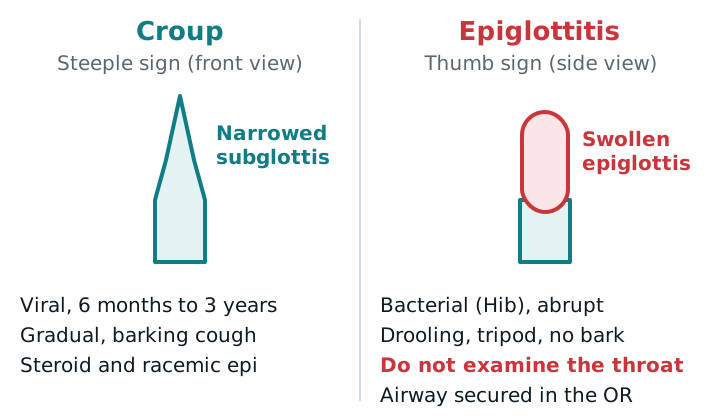
| Croup | Epiglottitis | |
|---|---|---|
| Cause | Virus (parainfluenza) | Bacteria (Hib) |
| Age | 6–36 months | Often 2–8 years |
| Onset | Gradual | Abrupt |
| Cough | Barking | Uncommon |
| X-ray | Steeple (subglottic narrowing) | Thumb (swollen epiglottis) |
Bronchiolitis
Bronchiolitis is a viral lower-airway infection in children under 24 months, peaking at 2–6 months. RSV causes up to 80% of cases. It starts with a cold, then rapid breathing, retractions, wheezing, and sometimes apnea in young or premature infants. The diagnosis is clinical, and the care is supportive.
- Give oxygen to keep the SpO2 above 90%, and keep the infant hydrated.
- HFNC or CPAP can help infants at risk of failing and may avoid intubation. See HFNC.
- Do not give routinely: bronchodilators (not uniformly effective, and they do not reduce admissions), steroids for a first episode, antibiotics unless a bacterial infection is suspected, and ribavirin.
- Reasons to intubate include severe recurrent apnea, hypoxemia that does not respond to oxygen, CO2 retention, and inability to clear secretions.
Foreign-body aspiration and choking
For severe airway obstruction (cannot cough, cry, or breathe) per the 2025 AHA guidelines:
- Infants: cycles of 5 back blows then 5 chest thrusts. Never use abdominal thrusts in an infant.
- Children: cycles of 5 back blows then 5 abdominal thrusts.
- Continue until the object is out or the child becomes unresponsive, then start CPR (see CPR and resuscitation).
Study example
A 2-year-old has a barking cough, stridor only when crying, and SpO2 98%. The ED gives dexamethasone and he improves. A second child, age 4, arrives upright and drooling, leaning forward, and quiet, with a muffled voice and fever. You do not look in the mouth or lay her down. You stay with her and her parent, bring the airway equipment to the bedside, and call anesthesia to secure the airway in the OR.
See neonatal respiratory disorders and bronchodilators.
Sources
- Merck Manual Professional Edition. Croup.
- Merck Manual Professional Edition. Epiglottitis; Table: Differentiating Epiglottitis From Croup. https://www.merckmanuals.com/professional/ear-nose-and-throat-disorders/oral-and-pharyngeal-disorders/epiglottitis and
- Merck Manual Professional Edition. Bronchiolitis.
- Ralston SL, et al. Clinical practice guideline: the diagnosis, management, and prevention of bronchiolitis. Pediatrics. 2014;134(5):e1474-e1502.
- Lee JE, et al. Updated pediatric cardiopulmonary resuscitation: a comprehensive review of the 2025 guidelines. Anesth Pain Med (Seoul). 2026;21(2):150-161.