Study notesMechanical ventilation
Noninvasive ventilation (CPAP and bilevel)
When to use NIV, how IPAP, EPAP, and pressure support work, typical starting settings, how to adjust them, and when to intubate.
- COPD start criterionpH < 7.35With PaCO2 above about 49 mmHg (6.5 kPa), BTS
- Typical starting IPAP8–12 cm H2ORaise for tidal volume and rate
- Typical starting EPAP4–6 cm H2OOften titrated to 8–12
- Pressure supportIPAP − EPAPPeak inspiratory pressure ≤ 30 cm H2O
Noninvasive ventilation (NIV) gives positive-pressure support through a mask instead of a tube in the airway. It can rest tiring respiratory muscles and avoid intubation in the right patient. It works only if the patient is awake, cooperating, and protecting their own airway.
CPAP and bilevel
- CPAP delivers one constant pressure through the whole breath. It raises end-expiratory lung volume and oxygenation but gives no inspiratory assist.
- Bilevel delivers two pressures. IPAP is the pressure during inhalation. EPAP is the pressure during exhalation and works like PEEP. The difference is the pressure support that pushes tidal volume in.
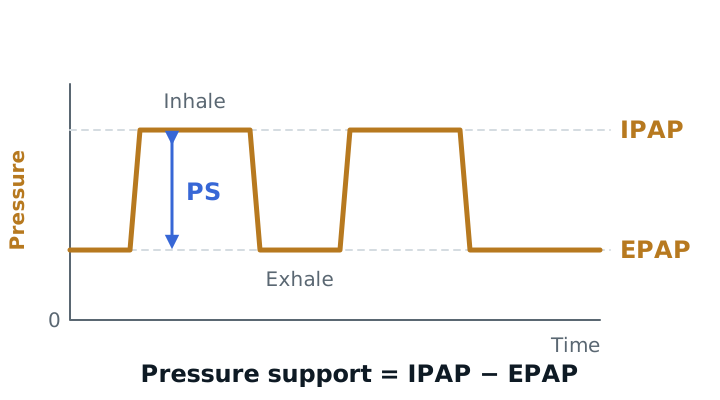
A backup rate (spontaneous/timed, or “S/T”) can be set so the patient still gets breaths if they stop triggering, which matters with hypercapnia.
Indications
- COPD exacerbation with acute hypercapnic respiratory failure. Start NIV when pH stays below 7.35 and PaCO2 stays above about 49 mmHg (6.5 kPa) despite medical treatment. The ATS 2026 guideline makes a strong recommendation for NIV in acute hypercapnic failure.
- Acute cardiogenic pulmonary edema. The ERS/ATS guideline recommends either CPAP or bilevel.
- Acute hypoxemic respiratory failure. HFNC is the strong recommendation; NIV or CPAP is a conditional one, with close monitoring and a low threshold to escalate.
- Other selected uses include preoxygenation before intubation and post-extubation support for high-risk patients.
Contraindications
Facial trauma or abnormal anatomy that stops a mask from sealing, hemodynamic instability, bowel obstruction or severe abdominal distension, impaired consciousness or inability to protect the airway, and copious secretions or active vomiting. If a patient has comfort-only goals and refuses intubation, NIV may still be reasonable.
Starting settings
One review gives a reasonable approach: EPAP 4–6 cm H2O (often raised toward 8–12 to improve triggering) and IPAP 8–12 cm H2O, then raise IPAP until tidal volume and rate are acceptable. Keep peak inspiratory pressure ≤ 30 cm H2O. Pressure support in the 8–15 range is commonly adequate. The BTS guideline recommends a full face mask as the first interface; see mask types.
| Problem | Adjustment |
|---|---|
| PaCO2 high, tidal volume small | Raise IPAP (more pressure support). Check for leak. |
| Hypoxemia | Raise FiO2 and EPAP. COPD patients are usually kept near SpO2 88–92%. |
| Chest/abdominal paradox, upper-airway obstruction | Raise EPAP. |
| Trigger missed or breaths cycling on their own | Adjust trigger sensitivity and fix the leak. |
| Poor chest expansion despite triggering | Raise IPAP. |
Signs of failure
Worsening hypoxemia, rising PaCO2 or falling pH, persistent work of breathing, falling consciousness, or a new contraindication such as vomiting. Failure rates of 15–38% are reported in acute respiratory failure, and a delay in intubation worsens outcomes. Asynchrony from mask leak, poor trigger setup, and a patient who is anxious or uncomfortable all push toward failure, so fix them early.
Study example
A COPD patient is drowsy but arousable with pH 7.28 and PaCO2 68 mmHg. Bilevel is started at IPAP 10, EPAP 5, so pressure support is 5. His tidal volume is small and the RR is 30. IPAP is raised to 16 and EPAP stays at 5, giving pressure support of 11. Tidal volume improves and the RR falls to 22. If the repeat ABG shows pH 7.20 and he becomes harder to wake, that is failure and the plan changes to intubation.
See oxygen mask types, HFNC, COPD, and ventilator liberation.
Sources
- Criner GJ, et al. Clinical review of non-invasive ventilation. Eur Respir J. 2024.
- Davidson AC, et al. British Thoracic Society/Intensive Care Society guideline for the ventilatory management of acute hypercapnic respiratory failure in adults. BMJ Open Respir Res. 2016.
- Rochwerg B, et al. Official ERS/ATS clinical practice guidelines: noninvasive ventilation for acute respiratory failure. Eur Respir J. 2017;50(2):1602426.
- Goel NN, et al. Noninvasive respiratory support for adult patients with acute respiratory failure: an official ATS Clinical Practice Guideline. Am J Respir Crit Care Med. 2026;212(9):2135-2158.