Study notesMechanical ventilation
Ventilator modes: control, trigger, limit, cycle
Read any mode by asking what the ventilator controls, what starts the breath, and what ends it. Covers A/C, SIMV, PSV, CPAP, and adaptive modes.
- Pressure trigger-1 to -3 cm H2OBelow baseline pressure
- Flow trigger2–3 L/minUsually more sensitive than pressure
A mode is the rule set a ventilator follows for every breath. Mode names differ by brand, but every mode can be read the same way: what does the machine control, what starts a breath, what ends it, and which breaths does the patient get?
Control variable: volume or pressure
The ventilator can control only one of these during inspiration, and the other one follows the patient’s lungs.
| Volume control (VC) | Pressure control (PC) | |
|---|---|---|
| You set | Tidal volume and flow | Inspiratory pressure and time |
| Stays constant | Volume and flow pattern | Pressure |
| Changes with the lungs | Airway pressure | Tidal volume |
| Pressure-time shape | Rises through the breath | Square |
| Flow-time shape | Constant (square) or decelerating | Decelerating |
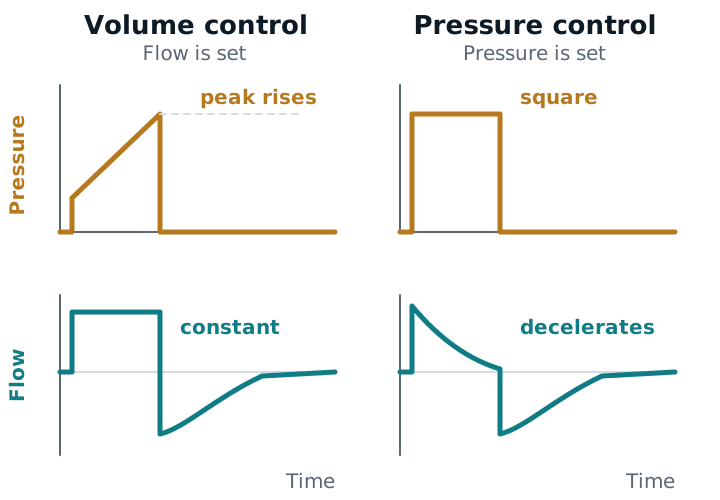
Why it matters: in VC, a stiffer lung shows up as a higher pressure. In PC, a stiffer lung shows up as a smaller tidal volume. Watch the variable that is not controlled.
Trigger, limit, cycle
- Trigger is what starts inspiration. It is either time (the set rate) or the patient (a small drop in airway pressure or a change in flow). Typical pressure triggers are -1 to -3 cm H2O; flow triggers are about 2–3 L/min. Too insensitive and the patient works hard; too sensitive and the ventilator auto-triggers.
- Limit is the value the breath may not exceed while inspiring: flow in VC, pressure in PC.
- Cycle is what ends inspiration: volume or time for most mandatory breaths, flow (a percentage of peak flow) for pressure support.
Breath sequences
| Mode | What the patient gets |
|---|---|
| CMV (controlled) | Set rate only, time-triggered. Patient effort is ignored, so it fits only a paralyzed or deeply sedated patient. |
| A/C (assist-control) | Every breath, whether time- or patient-triggered, is the same full set breath. Tachypnea can cause breath stacking and auto-PEEP. |
| SIMV | A set number of mandatory breaths, synchronized to the patient. Extra spontaneous breaths get no support unless pressure support is added (SIMV + PS). |
| PSV (pressure support) | Every breath is patient-triggered and assisted to a set pressure, then flow-cycled. The patient controls rate and, partly, tidal volume. There is no backup rate unless the machine provides one. |
| CPAP | One constant pressure, spontaneous breaths, no added inspiratory support. |
Adaptive (dual-control) modes
Names such as PRVC, VC+, and APV describe the same idea: a pressure-controlled breath whose pressure the ventilator adjusts breath to breath to reach a set tidal volume. You get the decelerating flow of PC with a volume target. The ventilator is also free to raise pressure when compliance falls or to lower it when the patient pulls harder, so read the displayed pressure, not just the set volume.
Study example
A patient is on VC at a tidal volume of 450 mL with constant flow. The peak pressure climbs from 28 to 38 cm H2O over several hours while the volume stays at 450 mL. Because volume is the controlled variable, the extra load shows up as pressure. If the same patient were on PC at 20 cm H2O, the pressure would stay at 20 and the delivered tidal volume would fall instead.
See initial ventilator settings, ventilator graphics, noninvasive ventilation, and ventilator brands.
Switch between VC and PC on the same patient in the ventilator simulator and watch which variable changes.
Sources
- Chatburn RL, El-Khatib M, Mireles-Cabodevila E. A taxonomy for mechanical ventilation: 10 fundamental maxims. Respir Care. 2014;59(11):1747-1763.
- Bayram B, Sanci E. Invasive mechanical ventilation in the emergency department. Turk J Emerg Med. 2019.
- Emrath E. The basics of ventilator waveforms. Curr Pediatr Rep. 2021.
- van der Staay M, Chatburn RL. Advanced modes of mechanical ventilation and optimal targeting schemes. Intensive Care Med Exp. 2018.
- Egan's Fundamentals of Respiratory Care (chapter on mechanical ventilation modes).