Study notesMechanical ventilation
Adjusting ventilation from ABGs
Change rate or tidal volume to fix PaCO2 and pH, and change FiO2 and PEEP to fix PaO2. Includes the rate formula and a worked example.
- Rate formula(rate × PaCO2) ÷ goalAssumes VT and dead space stay the same
- ARDS pH goal7.30–7.45ARDSNet protocol
- Max set rate35/minARDSNet protocol
- ARDS oxygenationPaO2 55–80 mmHgOr SpO2 88–95% (ARDSNet)
An ABG on a ventilated patient answers two separate questions. PaCO2 and pH tell you whether ventilation is right. PaO2 tells you whether oxygenation is right. Each question has its own knobs, and mixing them up is the usual mistake.
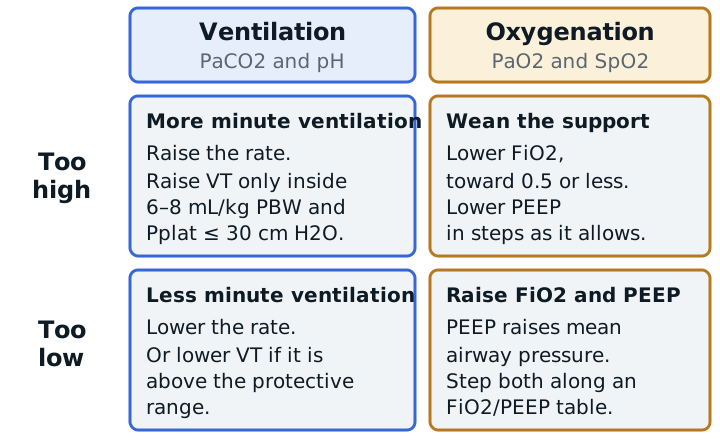
Ventilation: PaCO2 follows alveolar ventilation
CO2 leaves through the alveoli, so PaCO2 is inversely related to alveolar ventilation. Double the alveolar ventilation and PaCO2 roughly halves. Minute ventilation is VT × rate, and the two ways to change it are:
- Rate: the first choice. It does not stretch the lungs.
- Tidal volume: keep it in the protective range (6–8 mL/kg PBW, plateau pressure ≤ 30 cm H2O). In ARDS, ARDSNet raises the rate for acidosis and lowers VT when plateau pressure is high.
The rate formula:
New rate = (current rate × current PaCO2) ÷ desired PaCO2
The same ratio works for VT, but it is only an estimate. It assumes dead space stays the same and that the patient is not triggering extra breaths. Recheck the ABG after the change.
ARDSNet rules for acidosis: if pH is 7.15–7.30, raise the rate until pH is above 7.30 or PaCO2 is below 25 mmHg, to a maximum set rate of 35/min. If pH is below 7.15, set the rate to 35 and raise VT in 1 mL/kg steps if needed, even if plateau pressure goes above 30. Severe airflow obstruction is the opposite case: a high rate traps air, so accept a higher PaCO2. The BTS guideline allows permissive hypercapnia to a pH of 7.2–7.25 when high airway pressures are the risk.
A rate increase shortens expiratory time. Check the flow-time scalar for auto-PEEP afterward (see ventilator graphics).
Oxygenation: FiO2, PEEP, and mean airway pressure
PaO2 depends on FiO2 and on mean airway pressure, which PEEP raises most. Longer inspiratory time and higher peak pressure also raise it.
- FiO2 works well when the problem is a V/Q mismatch. It works poorly when blood passes through unventilated alveoli (shunt), because those alveoli never see the oxygen.
- PEEP keeps collapsed alveoli open and treats shunt-type hypoxemia, as in ARDS and pulmonary edema. Too much PEEP can overdistend lungs and reduce venous return, so watch blood pressure.
- Keep FiO2 as low as the goal allows. One review advises lowering it below 0.5 when possible.
The ARDSNet lower-PEEP/higher-FiO2 table pairs the two so you raise or lower them in steps. It uses a PEEP floor of 5 and an oxygenation goal of PaO2 55–80 mmHg or SpO2 88–95%. (The AARC cites 88–93% in ARDS.)
| PEEP (cm H2O) | Paired FiO2 |
|---|---|
| 5 | 0.3–0.4 |
| 8 | 0.4–0.5 |
| 10 | 0.5–0.7 |
| 12 | 0.7 |
| 14 | 0.7–0.9 |
| 16 | 0.9 |
| 18–24 | 0.9–1.0 |
Study example
A man with PBW 73 kg is on VC, VT 440 mL (6 mL/kg), rate 14/min. His ABG: pH 7.22, PaCO2 62 mmHg, PaO2 70 mmHg on FiO2 0.5 and PEEP 8.
- Ventilation: rate = (14 × 62) ÷ 40 = 21.7, so set 22/min. Minute ventilation rises from 6.2 to 9.7 L/min.
- Why not raise VT? The same ratio gives 440 × 62 ÷ 40 = 682 mL, or 9.3 mL/kg. That is outside the protective range, so the rate is the right knob.
- Check: at 22/min the whole breath is 2.7 seconds, so expiratory time shrinks. Look at the flow-time scalar for auto-PEEP and repeat the ABG.
- Oxygenation: PaO2 of 70 is inside the ARDSNet goal, so leave FiO2 and PEEP alone.
See ABG interpretation, initial ventilator settings, capnography, and ARDS.
Try the rate formula on the ventilator simulator, where the blood gas responds to each change.
Sources
- ARDS Network (NIH NHLBI). Mechanical ventilation protocol summary.
- Goodfellow LT, et al. AARC Clinical Practice Guideline: Patient-ventilator assessment. Respir Care. 2024;69(8):1042-1054.
- Bayram B, Sanci E. Invasive mechanical ventilation in the emergency department. Turk J Emerg Med. 2019.
- Davidson AC, et al. BTS/ICS guideline for the ventilatory management of acute hypercapnic respiratory failure in adults. BMJ Open Respir Res. 2016.
- Egan's Fundamentals of Respiratory Care (chapters on ABG interpretation and ventilator management).