COPD: staging, exacerbations, and oxygen
GOLD grades, exacerbation treatment, the 88–92% oxygen target, NIV criteria, and who qualifies for long-term oxygen.
- DiagnosisFEV1/FVC < 0.70Measured after a bronchodilator
- Exacerbation SpO2 target88–92%Titrate oxygen; recheck blood gases
- NIV triggerpH ≤ 7.35 + PaCO2 ≥ 45Or severe dyspnea, fatigue, or refractory hypoxemia (GOLD)
- Long-term O2PaO2 ≤ 55 / SpO2 ≤ 88%At rest, stable, confirmed twice
COPD is a lung disease with persistent airflow obstruction that is not fully reversible. It comes from damage to the airways (chronic bronchitis, small-airway disease) and to the alveoli (emphysema). You will meet these patients in the ED, on the floor, and on home oxygen, and the two decisions that matter most to you are how much oxygen to give and when to move to noninvasive ventilation (NIV).
Diagnosis and staging
Spirometry confirms COPD: a post-bronchodilator FEV1/FVC below 0.70. The grade comes from the post-bronchodilator FEV1 as a percent of predicted, and only applies once the ratio is under 0.70.
| GOLD grade | Severity | FEV1 % predicted |
|---|---|---|
| 1 | Mild | 80 or more |
| 2 | Moderate | 50 to 79 |
| 3 | Severe | 30 to 49 |
| 4 | Very severe | Under 30 |
Patients complain of shortness of breath, cough, and sputum. Trapped air drives most of what you see on a chest X-ray: a flattened diaphragm, more air space behind the sternum, dark (hyperlucent) lungs, and blood vessel markings that taper quickly toward the edges.
Exacerbations
An exacerbation is worsening shortness of breath, cough, or sputum over less than 14 days. Pneumonia, heart failure, and pulmonary embolism look similar, so keep them in mind. GOLD’s treatment points:
- Short-acting inhaled beta2-agonists, with or without a short-acting anticholinergic, are the first bronchodilators.
- Systemic corticosteroids for severe exacerbations, for up to 5 days.
- Antibiotics when indicated (for example, purulent sputum), for 5 days.
- Methylxanthines are not recommended.
- Start long-acting maintenance bronchodilators as soon as possible.
Oxygen
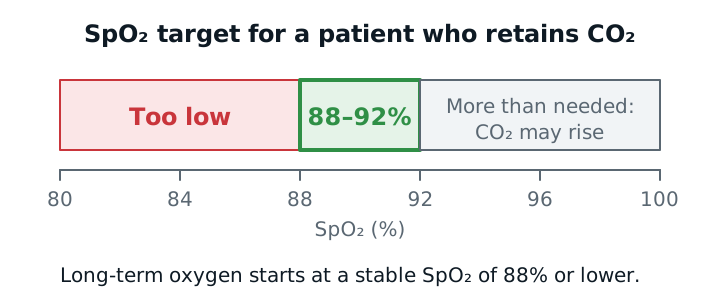
Titrate oxygen to an SpO2 of 88 to 92% and check blood gases often, to make sure oxygenation improves without CO2 retention or worse acidosis. Pulse oximetry doesn’t tell you the PaCO2, and it can read too high in patients with darker skin, so the ABG is your check. See pulse oximetry and ABG interpretation.
When to use NIV
GOLD says NIV is the first mode of ventilation for acute respiratory failure in a COPD exacerbation unless there is an absolute contraindication. It improves gas exchange, lowers work of breathing, and reduces intubation. GOLD lists these indications, and one of them is enough:
- Respiratory acidosis: PaCO2 of 45 mmHg or more and arterial pH of 7.35 or less.
- Severe dyspnea with signs of respiratory muscle fatigue or more work of breathing (accessory muscle use, paradoxical abdominal motion, retracting intercostal spaces).
- Persistent hypoxemia despite supplemental oxygen.
Intubation is for NIV failure, a patient who can’t tolerate NIV, cardiac or respiratory arrest, and similar problems. GOLD reports that once a patient can breathe unassisted for at least 4 hours, NIV can be stopped without a slow wean. High-flow nasal oxygen is used in selected patients; see HFNC.
Long-term oxygen therapy
Long-term oxygen is for stable patients with resting PaO2 at or below 55 mmHg, or SpO2 at or below 88%, confirmed twice over three weeks. It is also for those with a PaO2 between 55 and 60 mmHg (or SpO2 of 88%) when there is pulmonary hypertension, edema that suggests heart failure, or polycythemia (hematocrit above 55%). Some textbooks print “56 to 59”; the GOLD report uses 55 to 60. Recheck after 60 to 90 days to see whether oxygen is still needed.
Study example
A 68-year-old with COPD arrives short of breath on room air with an SpO2 of 83%. The ABG shows pH 7.28, PaCO2 68 mmHg. You start controlled oxygen aimed at 88–92%, give a short-acting bronchodilator, and the team adds steroids. The acidosis meets the NIV criteria, so you set up bilevel NIV and repeat the ABG after the change to see whether the pH is climbing.
Related: spirometry, HFNC, oxygen masks, MDI technique, asthma.
Ventilate the COPD patient to their baseline in the ventilator simulator.
Sources
- Global Initiative for Chronic Obstructive Lung Disease (GOLD). Global Strategy for Prevention, Diagnosis and Management of COPD: 2025 Report.
- Global Initiative for Chronic Obstructive Lung Disease (GOLD). Global Strategy for Prevention, Diagnosis and Management of COPD: 2026 Report.
- Global Initiative for Chronic Obstructive Lung Disease (GOLD). Pocket Guide to COPD Diagnosis, Management, and Prevention: 2025.
- Kacmarek RM, Stoller JK, Heuer AJ. Egan's Fundamentals of Respiratory Care. Elsevier.