NBRC exams: how the pathway works and how to study
The TMC, the CSE, and the new 2027 Respiratory Therapy Examination, with their formats and dates, plus practical study and test-taking strategy.
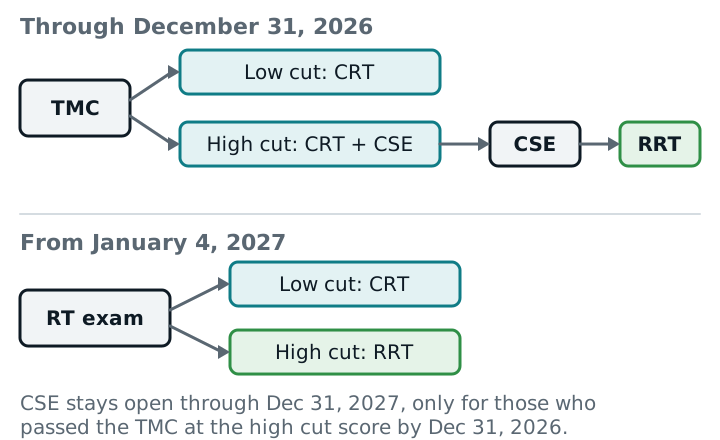
- TMC (through 12/31/2026)160 items, 3 h140 scored; two cut scores
- CSE22 problems, 4 h20 scored; leads to the RRT
- RT Exam (from Jan 4, 2027)185 items, 4 h160 scored; low cut CRT, high cut RRT
- CSE last availableDec 31, 2027Only for TMC high-cut passers
The National Board for Respiratory Care (NBRC) awards the CRT (Certified Respiratory Therapist) and RRT (Registered Respiratory Therapist) credentials. The pathway changes at the start of 2027, so which exam you take depends on when you test. This page lays out the facts from the NBRC and then gives study habits that work on any of these exams. The NBRC can change dates and rules, so check nbrc.org before you apply.
The pathway through 2026: TMC then CSE
- The Therapist Multiple-Choice (TMC) exam has 160 multiple-choice items (140 scored, 20 pretest) in 3 hours. It has two cut scores. The lower cut score earns the CRT. The higher one also earns the CRT and makes you eligible for the CSE, if you meet the CSE admission requirements.
- The Clinical Simulation Examination (CSE) has 22 patient problems (20 scored, 2 pretest) in 4 hours. Each is a clinical setting you work through. Passing it earns the RRT.
- The TMC’s last testing day is December 31, 2026. The CRT-to-Registry admission route also ends that day.
The pathway from 2027: one RT exam
- Testing on the new Respiratory Therapy Examination begins January 4, 2027. It has 185 multiple-choice items (160 scored, 25 pretest) in 4 hours.
- It has two cut scores: the lower earns the CRT, and the higher earns the RRT. There is no separate CSE step for new candidates.
- Eligibility: age 18 or older, and graduation from a CoARC-accredited entry-into-practice program with at least an associate degree (or the Canadian CSRT RRT credential).
- The CSE stays available through December 31, 2027, only for people who pass the TMC at the high cut score. Everyone else earns the RRT by passing the new exam at the high cut score.
- A CRT who scores below the low cut keeps the CRT and can retest. Earlier TMC and CSE attempts do not count against the new exam’s attempt limit.
How to study
- Start from the content outline. The NBRC publishes a detailed content outline for each exam that lists what is tested. Turn it into a checklist and rate yourself on each line. Spend the most time where you are weakest and the exam weight is highest.
- Learn by system, then by decision. For each topic know the numbers, the reason behind them, and the next step. For example, know the 88–92% target, why oxygen raises PaCO2 in some COPD patients, and what you do when the patient drifts off the target.
- Practice under time. The RT exam allows about 1.3 minutes per item (240 minutes for 185 items). Do timed sets of 50 or more so pace becomes a habit. The NBRC also offers a free practice exam; see its RT page.
- Review every miss. Write why the right answer is right and why yours was wrong, and sort errors into knowledge gaps (you did not know it) and reading errors (you knew it but misread). They need different fixes.
- Rotate topics and revisit. Come back to formulas, ventilator math, and drug classes every week instead of once.
Reading the question
- Read the last line first. Know what is asked (the first, best, next, or most appropriate step) and then read the case for what matters.
- Use only the facts in the stem. If the stem gives an ABG, interpret it before you look at the options. Do not invent findings.
- Assess before you act. When the patient’s status is unclear or has changed, the best first step is often to check the patient, the monitor, or the equipment (airway, circuit, ABG, breath sounds) before you change a setting.
- Safety beats tinkering. If an answer fixes the immediate threat (airway, oxygenation, ventilation), it usually outranks an answer that improves comfort or fine-tunes.
- Watch the word that changes the question: initial versus definitive, most likely versus possible, except, not.
- Eliminate. Cross out options that are unsafe, not indicated, or not yet needed, and choose from what is left. A true statement can still be the wrong answer if it does not answer the question asked.
Study example
You get a practice question: a ventilated patient has a high-pressure alarm and a falling SpO2. Before you look at the options, state the order in your head: check the patient, confirm the tube and breath sounds, and disconnect and bag if you cannot fix it fast. Then read the options and cross out any that change settings first. After the set, you note that you missed two items because you skipped the word first, which is a reading error, and you add a habit of underlining it.
See ABG interpretation, oxygen therapy, and CPR and resuscitation.