Neuromuscular respiratory failure and the 20/30/40 rule
Watch vital capacity, MIP, and MEP trends in GBS, myasthenia, ALS, and high spinal injury, because ABGs and SpO2 change late.
- Vital capacity< 20 mL/kgOr a drop of more than 30% from baseline
- MIP (NIF)weaker than −30 cm H2OLess negative than −30
- MEP< 40 cm H2OWeak cough
- Peak cough flow> 160 L/minNeeded for an effective cough
In neuromuscular disease the lungs are fine and the pump is failing. Nerves or muscles can’t generate a deep breath or a strong cough, so the patient tires, retains secretions, and eventually can’t ventilate. The RT’s job is to catch that decline early, because by the time the ABG is abnormal the patient is already in trouble.
The usual causes
- Guillain-Barré syndrome (GBS): a fast-moving nerve disease with weakness that can reach the breathing muscles within days.
- Myasthenia gravis: weakness from a problem at the nerve-muscle junction; a myasthenic crisis is respiratory failure from that weakness.
- ALS (amyotrophic lateral sclerosis): progressive loss of motor neurons, with slow decline in respiratory muscle strength and often poor cough.
- High spinal cord injury: the diaphragm is driven by phrenic motor neurons at C3 to C5. Lesions there can cause diaphragm weakness or paralysis, and respiratory failure in severe cases.
What to measure
Bedside spirometry and pressure measurements show the trajectory. Patients often don’t look distressed: fast breathing and a visible struggle may be absent, especially with weak facial and throat muscles. Check:
- Vital capacity (VC or FVC), in mL/kg.
- Maximal inspiratory pressure (MIP or NIF), the strength of the inspiratory muscles.
- Maximal expiratory pressure (MEP), which reflects the cough.
The commonly taught “20/30/40” rule gives thresholds at which ventilatory support is usually considered: VC below 20 mL/kg, MIP weaker than −30 cm H2O, and MEP below 40 cm H2O, or a drop of more than 30% from baseline in any of them. These numbers come from observational data in GBS and myasthenia. Some papers print the pressure thresholds differently (for example, MIP below −40 and MEP below +30 in one GBS review), so check your course’s version.
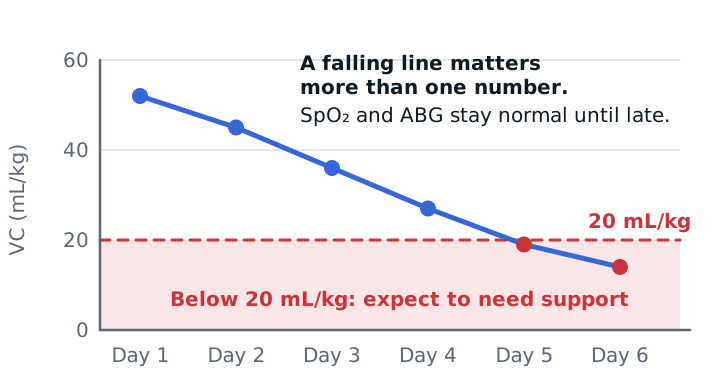
Trends matter more than a single value. For GBS, a bedside check such as lifting the head off the bed or counting on one breath (under 15 is concerning) can add to the picture, and a reported VC fall of more than 30% carries the same message.
Signs of failing muscles
- Paradoxical breathing, especially when lying flat. In diaphragm weakness the abdomen moves in as the chest expands on inspiration. In a low cervical injury, the chest wall can also move in, with a poor cough.
- Poor cough and trouble swallowing (bulbar weakness), and changes in mentation.
- SpO2 stays normal for a long time, because the saturation curve is flat at the top.
- ABG changes are late. Acidemia and hypercapnia usually signal severe failure; they aren’t reliable triggers for starting support.
Supporting the patient
Cough augmentation. A peak cough flow above 160 L/min is needed for an effective cough, and values below 270 L/min raise the risk of retained secretions and infection. Steps run from breath stacking (lung volume recruitment) and manually assisted cough to a mechanical insufflation-exsufflation (MI-E) device, which is the most effective and most used way to augment cough. See chest physiotherapy devices and airway suctioning.
NIV has a role, and in ALS, starting it early was associated with slower decline in FVC and respiratory muscle strength. Masks and settings need attention. See noninvasive ventilation.
Study example
A patient with GBS is 70 kg. VC was 3,200 mL on day 1 (46 mL/kg) and 2,000 mL on day 3 (29 mL/kg). On day 4 it is 1,300 mL, which is 19 mL/kg. His SpO2 is 96% and his ABG is normal. The VC has crossed 20 mL/kg and has fallen by over 50% from baseline, so you alert the team now and prepare for controlled intubation.
Related: spirometry, ABG interpretation, pulse oximetry.
Sources
- Respiratory issues and current management in neuromuscular diseases: a narrative review. J Thorac Dis. 2024.
- Acute neuromuscular syndromes with respiratory failure during COVID-19 pandemic: Where we stand and challenges. J Clin Neurosci. 2022.
- Critical insights for intensivists on Guillain-Barré syndrome. Ann Intensive Care. 2025.
- Respiratory consequences of cervical spinal cord injury: insights from preclinical models. Breathe. 2026.