Study notesTherapeutic procedures
Oxygen therapy: targets, devices, and hazards
Why and when to give oxygen, adult SpO2 targets, low-flow versus high-flow devices, FiO2 estimates for the nasal cannula, hazards, and weaning.
- Most acutely ill adultsSpO2 94–98%AARC 2022 and BTS
- Risk of CO2 retentionSpO2 88–92%COPD and other hypercapnic risks
- Nasal cannula1–6 L/minAbout 24–40% FiO2, varies with breathing
- Nonrebreather10–15 L/minAbout 60–90% FiO2 (BTS); some sources say 60–80%
- Toxicity riskFiO2 > 0.60Sustained exposure; use the lowest FiO2 that works
Oxygen therapy means giving oxygen above room-air concentration to treat or prevent hypoxemia. It is a drug: it has a dose (FiO2), a target (SpO2 or PaO2), and side effects. Your job is to pick the device that meets the patient’s need, aim for the right target, and turn it down when the patient no longer needs it.
Why and when
The AARC acute-care guideline defines documented hypoxemia as a PaO2 below 60 mmHg or an SaO2 below 90% on room air. Give oxygen to correct it, and in situations where hypoxemia is suspected, such as severe trauma or acute myocardial infarction (confirm it soon after starting). Oxygen does not fix hypoventilation or anemia by itself, so look for the cause.
Targets for adults
Titrate to a saturation range, not to “as high as possible.”
| Patient | SpO2 target |
|---|---|
| Most acutely ill or critically ill adults | 94–98% (AARC 2022, BTS) |
| COPD or other risk of CO2 retention | 88–92% (AARC 2022, BTS), pending blood gases |
| Critically ill with severe ARDS on a high-PEEP strategy | 88–93% (AARC 2022) |
Choosing a device
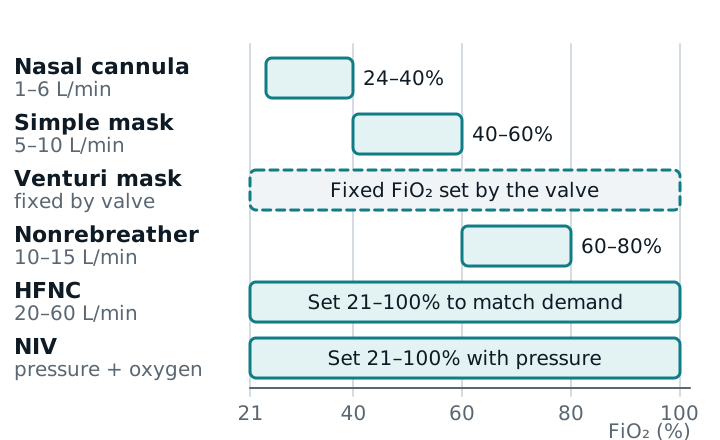
- Low-flow devices give less gas than the patient breathes in, so room air mixes in and the real FiO2 shifts with the breathing pattern. A bigger tidal volume or faster rate lowers the FiO2. These are the nasal cannula, simple mask, and nonrebreather.
- Nasal cannula: 1–6 L/min, about 24–40% FiO2. A rough rule is about 4% more FiO2 for each L/min above room air (1 L/min is about 24%, 6 L/min about 44%). It is an estimate only. Above 4 L/min the nose dries out, so consider humidity (AARC 2022).
- Simple mask: 5–10 L/min, roughly 40–60%.
- Nonrebreather: 10–15 L/min with the reservoir bag full, about 60–80% (Merck says leaks limit it to at most 80–90%).
- Venturi mask: a fixed, accurate FiO2 set by the valve, chosen when precision matters, as in COPD.
- High-flow systems meet or exceed the patient’s inspiratory flow, so the FiO2 you set is the FiO2 they get. HFNC runs 20–60 L/min with heated, humidified gas. See HFNC and oxygen mask types.
- NIV (CPAP or bilevel) adds pressure as well as oxygen. See noninvasive ventilation.
Hazards
- Oxygen-induced hypercapnia. In some patients with COPD, extra oxygen raises PaCO2. The main reasons are worse V/Q matching and the Haldane effect (oxygenated hemoglobin releases CO2). The older idea that oxygen “turns off the hypoxic drive” is mostly a myth. Treat the risk by targeting 88–92% and checking blood gases.
- Absorption atelectasis. High FiO2 washes nitrogen out of the alveoli. When the oxygen is absorbed, the unsupported units collapse.
- Oxygen toxicity. Sustained FiO2 above about 0.60 injures the lung. Use the lowest FiO2 that meets the target.
- Retinopathy of prematurity. Premature infants given high FiO2 are at higher risk of eye injury. Neonatal oxygen is tightly targeted; see neonatal respiratory disorders.
- Fire. Oxygen makes everything burn faster. No smoking, no open flame, and secure cylinders.
Weaning
When the patient is stable and the SpO2 is above the top of the target range, lower the FiO2 or flow in small steps and watch the SpO2. Stop when the patient holds the target on room air or on their baseline home oxygen. Oxygen given to someone who is not hypoxemic does not help and can harm.
Study example
A man with COPD arrives with SpO2 84% on room air and is started on a nasal cannula at 2 L/min. His SpO2 climbs to 90%, which is inside the 88–92% target, so the flow stays. His wife asks why you do not turn it up to get 98%. Higher oxygen could push his PaCO2 up, so you hold the target and check an ABG.
See oxygen mask types, HFNC, pulse oximetry, and COPD.
Sources
- Piraino T, et al. AARC Clinical Practice Guideline: Management of Adult Patients With Oxygen in the Acute Care Setting. Respir Care. 2022;67(1):115-128.
- British Thoracic Society. Guideline for oxygen use in healthcare and emergency settings (target saturation update, 2019).
- Merck Manual Professional Edition. Hypoxia in Hospitalized Patients.
- StatPearls. Oxygen Therapy. NCBI Bookshelf.
- Mein SA, Ferrera MC. Management of Asthma and COPD Exacerbations in Adults in the ICU. CHEST Critical Care. 2025;3(1):100107.
- AARC Clinical Practice Guideline: Oxygen Therapy for Adults in the Acute Care Facility, 2002 revision. Respir Care. 2002;47(6):717-720.
- AARC Clinical Practice Guideline: Oxygen Therapy in the Home or Alternate Site Health Care Facility, 2007 revision. Respir Care. 2007;52(1).