Pneumonia and VAP prevention
CAP, HAP, and VAP definitions, the signs and chest X-ray findings of consolidation, sputum collection, and the 2022 SHEA/IDSA/APIC prevention practices.
- HAP onset≥ 48 h after admissionNot incubating on arrival
- VAP onset> 48 h after intubationCounted from the intubation, not admission
- Head of bed30–45°SHEA/IDSA/APIC 2022 essential practice
- Ventilator circuitChange if soiledNot on a fixed schedule
Pneumonia is infection of the lung’s air sacs, which fill with pus and fluid so that parts of the lung can’t exchange gas. Where it was acquired changes the likely germs and the plan: CAP (community-acquired) starts outside the hospital, HAP (hospital-acquired) after admission, and VAP (ventilator-associated) after intubation. RTs are on the front line of VAP prevention, because most of the prevention practices involve the ventilator, the airway, and the bedside.
Definitions
- CAP: pneumonia acquired outside the hospital.
- HAP: pneumonia not incubating at the time of admission, with onset 48 hours or more after admission. It isn’t related to mechanical ventilation.
- VAP: pneumonia occurring more than 48 hours after endotracheal intubation.
The IDSA/ATS panel notes there is no gold standard for diagnosing HAP or VAP. The long-standing definition is a new lung infiltrate plus clinical evidence that it is infectious.
What you find
A typical bacterial pneumonia causes fever, chills, cough with purulent sputum, chest pain, and shortness of breath, with a raised white blood cell count. Over an area of consolidation, the exam shows dullness to percussion, increased fremitus, bronchial breath sounds (the classic sign of pneumonia with consolidation), and crackles. Bronchial breath sounds are loud and tubular because solid lung carries sound well.
On a chest X-ray, consolidation is a dense airspace opacity, often with air bronchograms: dark, air-filled bronchi visible against the white lung.
Sputum collection
Culture results guide antibiotic choice. For VAP, the guideline says cultures of respiratory secretions should be obtained from virtually all patients with suspected VAP; for HAP, noninvasive samples are suggested. For CAP, routine sputum Gram stain and culture is not recommended in outpatients, and is recommended before treatment for hospitalized patients with severe CAP (especially if intubated) or those treated for MRSA or Pseudomonas. Collect before the first antibiotic dose when you can without delaying treatment, use a sterile trap, label it, and send it promptly. See airway suctioning.
Preventing VAP
The 2022 SHEA/IDSA/APIC compendium separates essential practices (for every hospital) from additional approaches:
- Avoid intubation when possible: use high-flow nasal oxygen or NIV when it’s safe, and avoid reintubation.
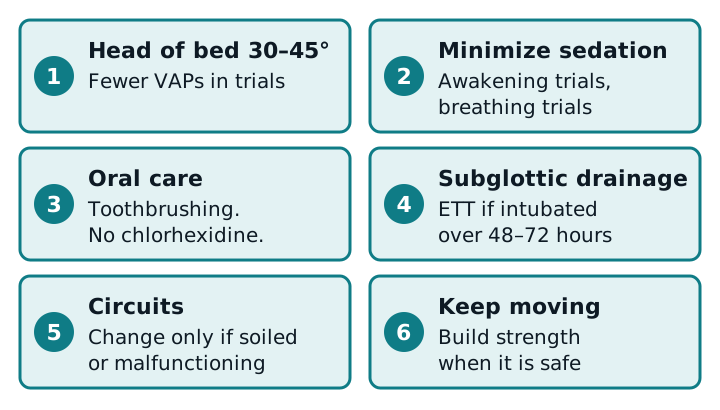
- Minimize sedation. Use awakening trials or sedation protocols, avoid benzodiazepines where you can, and use a ventilator liberation protocol with daily breathing trials. See ventilator liberation.
- Elevate the head of the bed to 30 to 45 degrees.
- Oral care with toothbrushing, without chlorhexidine (the 2022 update no longer recommends chlorhexidine).
- Change the ventilator circuit only if it is visibly soiled or malfunctioning. Routine fixed-schedule changes don’t lower VAP and cost more.
- Early mobility and maintaining physical conditioning, and early enteral rather than parenteral nutrition.
- Subglottic secretion drainage endotracheal tubes are now an additional approach, to consider when a patient is likely to be intubated for more than 48 to 72 hours.
The compendium does not recommend probiotics or automated or frequent cuff-pressure monitoring as VAP prevention measures.
Study example
A patient has been intubated for 4 days. Overnight she develops a fever, her secretions turn thick and yellow-green, and the X-ray shows a new right lower-lobe opacity with air bronchograms. Your exam finds dullness and bronchial breath sounds on the right. This is new pneumonia more than 48 hours after intubation, so it is a probable VAP. You collect a respiratory sample for culture, tell the team, and review the bundle: head of bed at 35 degrees, daily sedation interruption and breathing trial, and oral care.
Related: airway suctioning, chest physiotherapy devices, ARDS, HFNC.
Sources
- Klompas M, et al. Strategies to prevent ventilator-associated pneumonia, ventilator-associated events, and nonventilator hospital-acquired pneumonia in acute-care hospitals: 2022 Update (SHEA/IDSA/APIC). Infect Control Hosp Epidemiol. 2022.
- Infectious Diseases Society of America. Management of Adults with Hospital-acquired and Ventilator-associated Pneumonia: 2016 Clinical Practice Guidelines by IDSA and ATS.
- Metlay JP, et al. Diagnosis and Treatment of Adults with Community-acquired Pneumonia: An Official ATS/IDSA Clinical Practice Guideline. Am J Respir Crit Care Med. 2019.
- Murray and Nadel's Textbook of Respiratory Medicine: History and Physical Examination (Table 16-3).
- Chest radiography in adult critical care unit: a pictorial review. Indian J Radiol Imaging. 2019.